
Brisbane’s Ipswich Mounting a Property Comeback
Ipswich Granny Flats your Granny Flat experts, the largest builder and supplier of Granny Flats in SE Qld brings to you another great snippet about Ipswich – and it’s great property comeback!
Ipswich has joined the positive trend upwards, a flow on from Brisbane and the ripple effect. We are poised to return to previous status where bargain hunting investors are returning to the local area – which is great for us all!
Enjoy:
Brisbane’s Ipswich Mounting a Property Comeback:
Terry Ryder
http://www.propertyobserver.com.au/
6 November 2015
Ipswich, once the capital growth leader for the Brisbane metropolitan area and a favourite target for property investors from around Australia, is mounting a comeback after three years in the doldrums.
Up until 2013, Ipswich City dominated the growth rankings for Greater Brisbane. In a report early in 2013, I wrote: “Ipswich City is the capital gains star of the Brisbane metropolitan area. The municipality which encompasses the south-western fringe of the Greater Brisbane area has the top five suburbs for long-term capital growth. It has eight of the top 10 – and 15 of the top 25 suburbs.”
At that time, virtually every suburb of Ipswich had a long-term growth rate (average annual growth in median prices over the previous 10 years) above 10% per year. It had attracted home-buyers in large numbers and investors seeking affordable prices and above-average rental yields.
Today, after three down years, the same suburbs have long-term growth averages in the 4-5% range.
But the comeback has started, with the first compelling evidence seen in the latest quarterly figures. Hotspotting analysis of sales volumes shows that Ipswich City has belatedly joined the overall positive trend in the Brisbane market. The LGA now has eight suburbs with clear growth trajectories – double the number in the previous survey three months ago.
Brisbane’s real estate sector has been behaving quite differently to that in Sydney, where for much the past 2-3 years there has been double-digit price growth right across the metropolitan area.
In Brisbane, there has been growth in individual sectors, but it has not been widespread and the generalised growth figure for the city overall has been moderate at best.
The Brisbane North precinct was the first to get on a growth path about two years ago and many suburbs in that area recorded double-digit annual growth in median prices.
That market is no longer pumping to the same degree – sales activity has tapered off in most of those suburbs which were previously the market leaders of Greater Brisbane.
Now the southside has taken over. In our survey three months ago, Brisbane South was the market leader, with Logan City alongside. Now Logan City (the affordable urban bridge between Brisbane City and the Gold Coast) is the clear leader, with 18 growth suburbs, followed by Brisbane South with 13.
And starting to mount a challenge, well behind these other sectors in the cycle, is Ipswich City.
There was an inevitability about the Ipswich revival because this precinct ticks all the boxes. It is a perfect fit the “power combination” of factors that drives real estate markets – affordability plus infrastructure plus jobs nodes.
This area has a good supply of suburbs with median house prices in the $200,000s, ample land for future development, big government spending on infrastructure of all kinds, an ambitious and proactive council, and billions in investment from the private sector.
Many big businesses with major warehousing needs are based out there because the land is cheap and the transport links are good.
Entities involved in key current projects across Ipswich City include Mirvac, GPT, TNT Express, Devine, Lend Lease, Ramsay Health Care, the State Government, the Ipswich City Council and an array of major Asian companies.
As well as cheap entry prices, the area offers solid rental yields, typically in the 5.5% to 6% range.
Goodna is a fairly typical offering. It’s a modest but well-connected suburb, located on the Ipswich Motorway and the rail line to central Brisbane, close to multiple jobs nodes and not far from the extensive facilities of the Springfield master-planned community. It recorded 120 houses sales in the past year at a median price of $290,000 and median yield a little below 6%.
As the overall Ipswich City market rises, some suburbs are starting to deliver the kind of price growth that made Ipswich a capital growth star in the past. The suburbs of Ipswich, East Ipswich, Woodend and Yamanto have all had double-digit growth in median prices in the past 12 months, while others have grown between 5% and 10%.
I suspect it’s poised to return to the status that made it popular among bargain-hunting investors in the past.
Congratulations Ipswich, You’ve Done It Again!
Ipswich has again been named one of the world Smart21 Intelligent Communities of 2016 by the Intelligent Community Forum in Dublin Ohio USA last week.
Ipswich joins Armidale NSW as the only communities from Australia recognised for 2016.
Ipswich is in the running again for 2016 Top 7 recognition and then in contention for the 2016 Intelligent Community of the Year, to be named in June 2016 at the ICF Summit in Columbus, Ohio, USA.
Read the full story below…
http://www.intelligentcommunity.org
21 October 2015
The Intelligent Community Forum today named the world’s Smart21 Communities of 2016. This select group of communities will now be in contention for the prestigious designation of Intelligent Community of the Year in June 2016.
“We are very excited to name 11 new communities from North America, Europe and Asia to this year’s Smart21,” said ICF co-founder Robert Bell. “We streamlined our selection process this year, increasing the quantitative portion of the data-gathering and analysis, and that has created opportunities for more cities and counties to be included in consideration for this prestigious group of Smart21 Communities.”
The Smart21 Communities of 2016 are comprised of eight communities from Canada, five communities from Taiwan, two communities from the United States, two communities from Australia, and one community each from Germany, The Netherlands, New Zealand and Sweden.
NOTE – The Intelligent Community Forum produced a video about the Smart21 for 2016. It can be viewed here – www.youtube.com/watch?v=0ot9O7gSaVY
Intelligent Community Forum Smart21 Communities for 2016
| Community | Country | Population |
| Armidale, New South Wales | Australia | 25,327 |
| Brabantse Kempen Region | The Netherlands | 108,000 |
| Hamilton, Ontario | Canada | 520,000 |
| Hsinchu County | Taiwan | 540,193 |
| Ipswich, Queensland | Australia | 190,000 |
| Jönköping | Sweden | 132,000 |
| Kaohsiung | Taiwan | 2,770,000 |
| Lambton County, Ontario | Canada | 129,479 |
| Lethbridge, Alberta | Canada | 94,804 |
| Marlborough, Massachusetts | USA | 39,612 |
| Montreal, Quebec | Canada | 1,988,243 |
| Mülheim an der Ruhr | Germany | 169,398 |
| New Taipei City | Taiwan | 3,966,533 |
| Oshawa, Ontario | Canada | 160,051 |
| Ottawa, Ontario | Canada | 1,096,100 |
| San Diego, California | USA | 1,381,069 |
| Surrey, British Columbia | Canada | 514,390 |
| Taitung County | Taiwan | 224,470 |
| Taoyuan | Taiwan | 2,061,501 |
| Whanganui | New Zealand | 43,100 |
| Winnipeg, Manitoba | Canada | 782,640 |
.
The announcement of the Smart21 list was made at the conclusion of a one-day conference in Dublin, Ohio, USA launching a new ICF Institute for the Study of the Intelligent Community. The new Dublin Institute will be built as a collaborative effort among global public and private sector leaders, universities and research institutions. The Institute will also provide interested parties with knowledge and information on the Intelligent Community process. More information about the new institute can be found at http://globalinstitute.dublinohiousa.gov
Evaluation of Intelligent Community Forum Awards Program nominations is based on the six Intelligent Community Indicators, which provide the conceptual framework for understanding all of the factors that determine a community’s competitiveness and point to its success in the broadband economy. In addition, the Awards are guided by this year’s theme, From Revolution to Renaissance, which focuses on how Intelligent Communities plan their future at a time when the economy, the environment and the patterns of urban and rural life are undergoing dramatic change. Click here to find out more about this year’s theme.
The Smart21 Communities of 2016 will next provide more detailed data through an extensive questionnaire, which is evaluated by an independent research firm. The seven highest-scoring cities or regions will then be named the Top7 Intelligent Communities of the Year in February of 2016. In June of 2016, at an event in Columbus, Ohio, USA, the 2015 Intelligent Community of the Year, one community will be chosen to succeed Columbus as the 2016 Intelligent Community of the Year.
About Intelligent Community Forum
The Intelligent Community Forum (www.intelligentcommunity.org), headquartered in New York, is a global movement of more than 140 cities, towns and regions. As an international think tank and Foundation, ICF studies and promotes the best practices of the world’s Intelligent Communities as they adapt to the new demands and seize the opportunities presented by information and communications technology (ICT). To help cities and towns build prosperous economies, solve social problems and enrich local cultures, the Intelligent Community Forum conducts research, hosts global events, publishes books, and produces its high-profile annual international awards program. The Forum has two Institutes in North America dedicated to the study of the movement, with more institutes planned. Global leaders, thinkers, and media observers follow and participate in the ongoing global dialogue initiated by the Intelligent Community Forum. In 2012 ICF was invited to participate at the Nobel Peace Prize conference in Oslo and in 2014, its model and work was recognized by the U.S. Department of Commerce under the Workforce Innovation and Opportunity Act, which, according to the American government, was “aimed at creating a more flexible and responsive system of workforce development to meet the needs of employers looking to fill 21st century jobs.” The Forum’s Foundation has an association made up of 134 designated Intelligent Communities worldwide, which is represented by mayors and key civic leaders. For more information, go to www.icf-foundation.org. For more details on the Intelligent Community Forum’s recent publications and programs, www.intelligentcommunity.org
Housing Affordability Deteriorating as Earnings Flatline & House Prices Increase
Staff Writer
http://www.architectureanddesign.com.au
5 November 2015
Sluggish earnings growth and the strong pace of dwelling price increase in the two key markets of Sydney and Melbourne is causing deterioration of housing affordability.
That’s according to the Housing Industry Association (HIA) whose recently-released HIA Affordability Index for the September 2015 quarter shows that home purchasing is moving beyond the reach of a greater number of Australian families.
According to the report, housing affordability during the September 2015 quarter worsened by 4.0 per cent compared to the previous quarter and was 2.1 per cent less favourable than the same time last year. Affordability of developments in the eight capital cities also suffered a 4.1 per cent deterioration compared to the previous quarter, and was 3.6 per cent less favourable than a year ago. However, affordability actually improved in six of the fourteen markets included in the report.
Observing that affordability was now at its least favourable since the final quarter of 2014, HIA Senior Economist Shane Garrett said the two interest rate reductions in the first half of this year provided a temporary respite from the perspective of affordability. However, the surge in dwelling prices in Sydney and Melbourne, along with near stagnant earnings growth means that housing affordability continues to be impacted.
The commencement of over 210,000 new dwellings during the 2014/15 financial year has created a remarkable pipeline of supply, providing some relief to affordability pains. However, Garrett believes there is still a long way to go before more affordable housing can be achieved.
The burden of taxation on new housing combined with chronic shortages of new residential land in key markets is impeding any progress towards the goal of affordable housing. He added that the unilateral increase in variable mortgage rates over the past month has further aggravated the situation.
Housing affordability is a big issue across the board and one of the ways Ipswich City Council has answered this is by allowing granny flats to be built for others than immediate family members.
Here at Ipswich Granny Flats we have found that roughly 1 in 4 granny flats that we build are for immediate family members! More and more families are deciding that living and sharing the same property might not be such a bad idea after all. The kids and their family live in the main house with grandma and grandpa living in the newly built granny flat in the backyard – what a great thing!
A Great Solution – brought to you by Ipswich Granny Flats, the largest supplier of granny flats in Ipswich, Logan, Brisbane and SE Queensland.
DO YOU HAVE A SPARE BACKYARD?
WANT TO MAKE SOME EXTRA MONEY?
Call Sonia, Ipswich Granny Flats
0403 309 136
Sydney in the Midst of a ‘Granny Flat Boom’
Ipswich Granny Flats, your local Granny Flat Experts, bring to you another interesting snippet from the Sydney Granny Flat Market…
Ingrid Fuary-Wagner
www.domain.com.au
4 November 2015
Sydney in the midst of a ‘granny flat boom’
When Penelope Roberts and her husband Nicholas bought their Federation home in Randwick back in 2006, the dilapidated old shack in the garden required serious consideration.
The structure in question was an old stable where the original well-to-do owners had once kept their horse.
“I liked the stable because I’m a country girl, but it was really run down,” Roberts says.
 Penelope Roberts thinks her family’s Randwick granny flat will be a drawcard for potential buyers. Photo: Edwina Pickles
But her husband immediately saw the potential of turning it into a functional, habitable space.
“We also knew it was a drawcard because at that point it was hard to get a second dwelling approved,” she says.
 The backyard granny flat at 18 Oswald Street in Randwick used to be a stable where the original owners kept their horse. Photo: Edwina Pickles
That was before the law changed in 2009, allowing granny flats – or second dwellings as they are officially called – to be approved within 10 days and to be built within all residential zones across NSW.
Since then, NSW has experienced huge growth in granny flats, with a 260 per cent increase over five years to June 2014.
Associate Director at research house BIS Shrapnel, Kim Hawtrey, says that while there’s been a lot of focus on the construction ‘boom’ of high-density developments, the rise in the affordable alternative has gone largely unnoticed.
“It is a granny flat boom. We are building almost 5000 granny flats a year in New South Wales,” Hawtrey says.
That figure translates to nearly one granny flat for every 10 new dwellings approved.
According to Hawtrey, there are plenty of reasons why second dwellings have become so popular, including the fact that children are living with their parents longer as well as an ageing baby boomer population.
“You could get a $400,000 apartment or you could build a $150,000 granny flat – so it’s the cheaper option.”
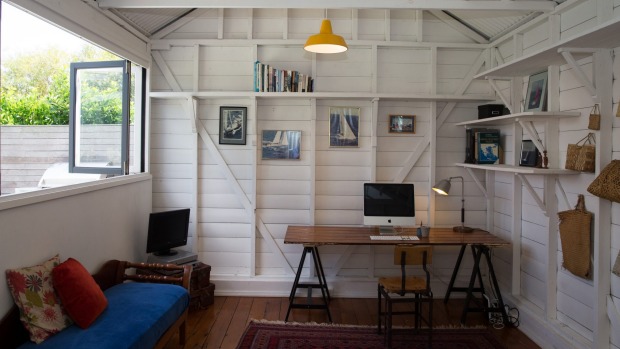 The Roberts family has used their granny flat as a home office, guest house and extra space for two teenage boys. Photo: Edwina Pickles
Then there’s the surge in overseas migration, with anecdotal evidence suggesting granny flats are more prevalent in areas with a greater proportion of migrant families.
“International buyers often have multi-generational members of the family around,” Hawtrey explains.
“It means family members can come and stay or live and still have a degree of independence.”
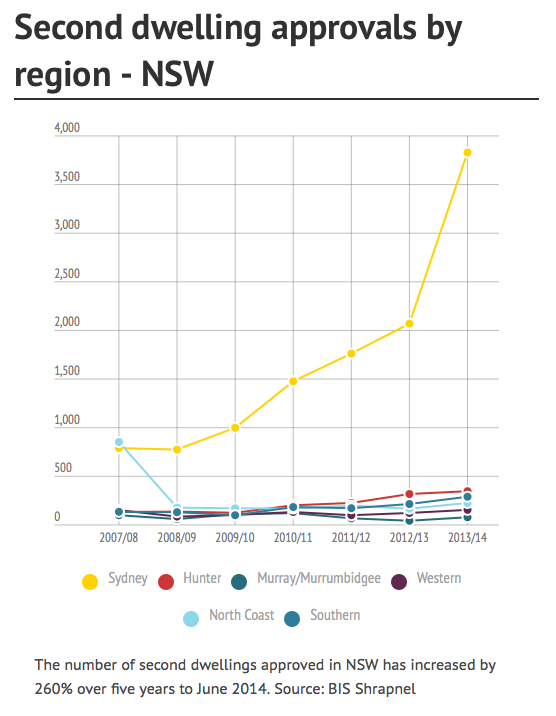 Investors are also tapping into this opportunity, with the potential to earn two lots of rent from one property.
The BIS Building Industry Prospects report shows that a granny flat can improve the rental income on the median house in Sydney from 2.5 per cent to 3.6 per cent – a return of $300 extra per week.
Some home owners are even moving into their granny flats and renting out their main homes, Hawtrey says.
Within Sydney, Bankstown, Blacktown and Parramatta in particular are seeing an increase in granny flats.
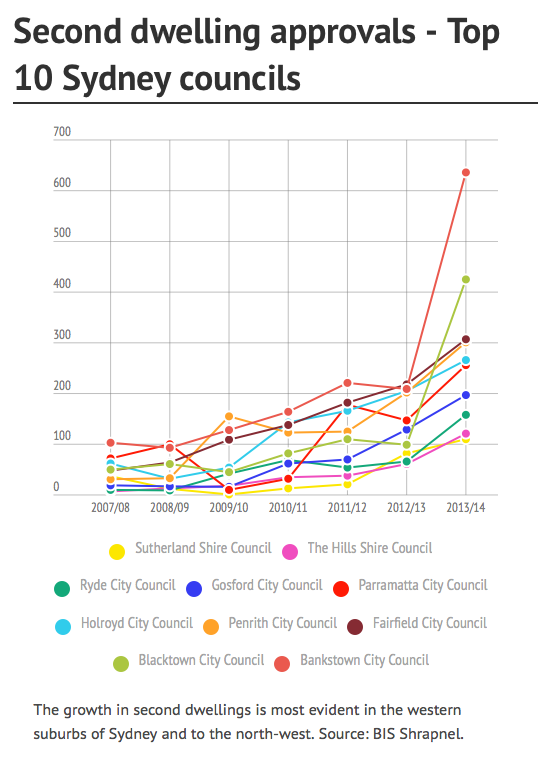
Hawtrey says people have come up with ways to deal with the affordability crisis by making use of the quarter acre block.
“It goes to show we don’t necessarily just need high rise buildings to solve the issue of a booming population and affordability crisis.”
For Penelope Roberts, her backyard stable turned granny flat has been used as a home office, an extra space for her teenage sons and a guest house where visitors can come and go as they please.
And now that her home is on the market, she thinks the second dwelling will definitely add value to the property.
“I think it is a big drawcard for potential buyers – it’s effectively an extra room with the house. It could be put on Airbnb or rented out as well,” she says.
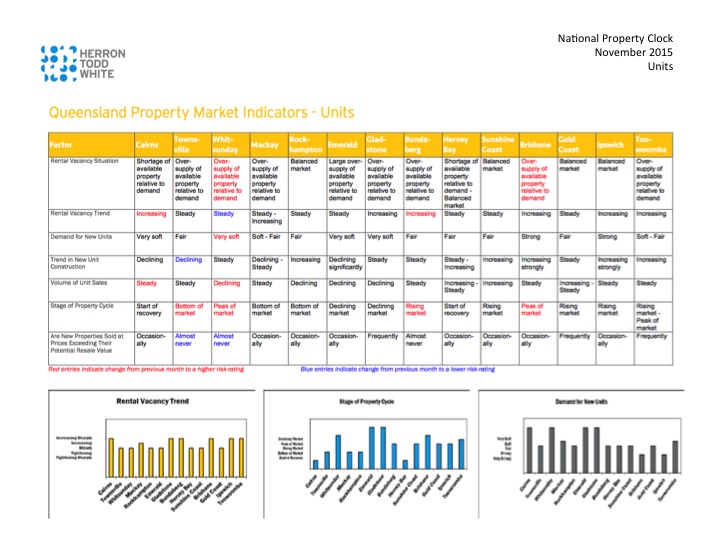
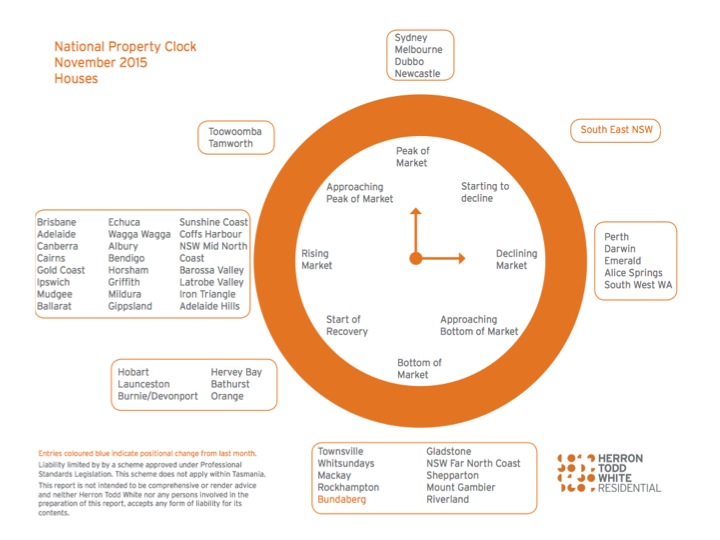
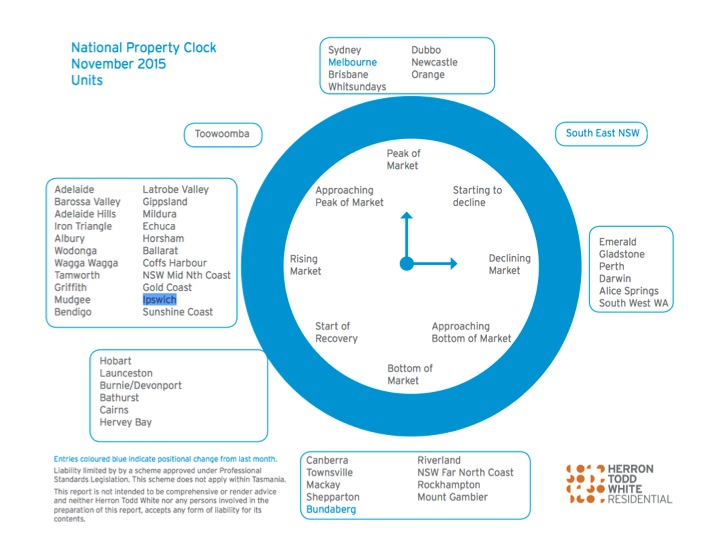
The National Property Clock
Another interesting snippet brought to you by Ipswich (or Logan) Granny Flats, the largest supplier of granny flats in Brisbane, Ipswich, Logan, Moreton Bay and the whole of SE Queensland…
Herron Todd White
The Month in Review
November 2015
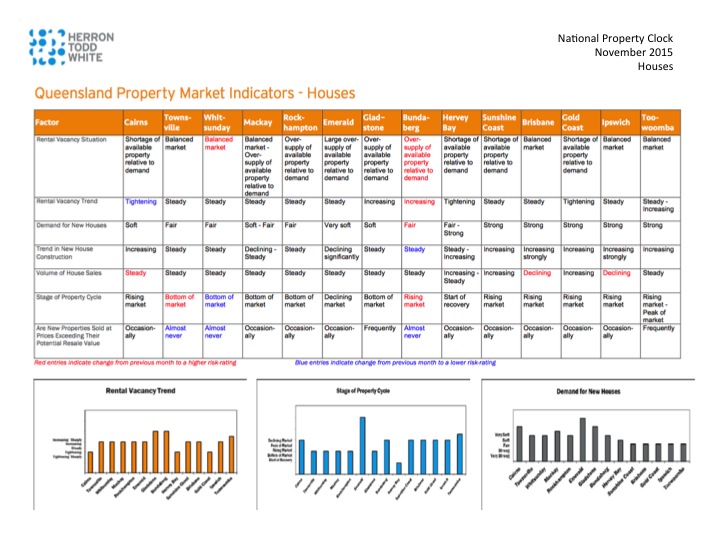
Checkout the golden triangle : Brisbane – Gold Coast – Ipswich and anything in between!
We’re on the rise so all you past, present and future investors : this is the place you need to be buying!
Would you Consider Going Small… Really, Really Small?
An interesting snippet brought to you by your Granny Flat Experts, Ipswich Granny Flats, the largest supplier of granny flats in Brisbane and SE Queensland…
Starts at Sixty Writers
http://www.startsatsixty.com.au/
13 October 2015

Would you consider going small… really, really small?
If there’s one thing we Aussies have in spades, it’s space. Consequently, we have some pretty big homes – the largest in the world, in fact.
For most boomers, however, the Era of Many Bedrooms is behind us. Reports have shown that almost half of us have already trimmed down our household by the time we reach retirement, with many more doing so after the event.
But, where once the question many have been ‘how big is big enough’, these days many are asking ‘how small can we go’?
You’ve probably heard about the Tiny Living movement, which sees people eschewing separate bathrooms, spare rooms and even living space in order to live small.
American architect Sarah Susanka’s book The Not So Big House, showed that clever design and a simple approach to life meant you could meet all your housing needs in as little as 30 square metres – one-eighth the size of the average Aussie castle.
Many of you reading this now will think, ‘no way!’ But there’s probably just as many who say ‘yes please’.
There’s something about being in a tiny space that makes your heart sing. Think about the times you’ve been on a boat, in a caravan or tucked away in a rural B&B somewhere. They’re simple times, with everything you could possibly need – and nothing you don’t.
Those who love the tiny living movement say that less space – a lot less space – provides more room in the mind, better connection with whomever you live with and an absence of clutter.
Of course, it’s not all connection, community and Kumbaya.
Having spent 10 months in a Volkswagen campervan, I can assure you the word ‘tiny’ quickly becomes ‘cramped’ – particularly when it rains for two weeks!
In America, tiny living is particularly popular with baby boomers, particularly those who identify with the hippy movement of the past. The trend today is for building miniature wooden homes on trailers and parking them wherever the council will let you.
Australia’s answer to the tiny living movement could be our legions of nomads, who are arguably living in tiny spaces that provide access to the vast ones.
Granny flats are also increasingly popular, whether they are in the back yard of a relative’s home, or on one’s own property – you can find more about that here. But there are restrictions. For example, in Victoria, a granny flat must be relocatable and accommodate people who are dependent on those in the main residence.
Last year, an expert in affordable housing told Fairfax media that a lack of suitable options for baby boomers wishing to downsize kept them trapped in their too-large homes. Do you feel this way? Would you do smaller if you could? And if so, how small would you go?
Would you consider living in a tiny home, caravan or granny flat on a permanent basis?