
Is the Recent Growth in Queensland Sustainable ?
Vision Property Group (Qld) and Ipswich Granny Flats : A timely article in the new issue of the HIA Queensland Building News!

Here in Ipswich we have certainly experienced a new found shortage of available land. Every investment group in Australia has realised you can now build a new house + an Auxiliary Dwelling, more commonly known amongst the investment fraternity as Dual Living (We Call Them Granny Flats!). And we don’t see it changing any time soon.
My personal belief is that by the end of this year (2014) we will have a severe shortage of residential land across SE Queensland, particularly in Ipswich. If you want to buy an investment property in 2014 – Ipswich is the place to be looking. It’s the old story of supply and demand, so get in now – be an industry leader, not a follower when it’s too late. Queensland’s south east corridor is one of the fastest growing regions in Australia – we are poised for huge growth, and have only just begun the journey …
Enjoy the read :
Is the Recent Growth in Qld Sustainable ?
Debbie Johnson, HIA President Queensland
HIA Qld Presidents Report
Building News Issue 2 / 2014, P7
As Darryll’s article explains, not all parts of Queensland have benefitted from the growth in the home building activity over the last year : most of the growth in both the new and multi-unit markets has been focused on South East Queensland.
Along with the geographic spread of the recovery, another topic that is often coming up in conversations with members is whether the recovery that we have felt is durable.
After such an extended period of depressed industry conditions it’s not surprising that home building and materials supply businesses are being cautious about taking on extra staff or investing more in stock or supply capacity.
“THE LAND ISSUE IS HOPEFULLY JUST A SHORT TERM PROBLEM AS DEVELOPERS WIND UP THEIR ACTIVITY TO MEET THE EXPANDING MARKET”

Forecasting is always an exercise in weighing up the risks of what can go wrong. But at the moment the risks of the recovery faltering are much less than the likelihood of it continuing to deliver improved trading conditions for a good while yet. The key to a sustainable recover is of course closely linked to continued confidence among the home buying public. In Queensland this group has every reason to remain optimistic :
- Interest rates are likely to stay at very low levels for the foreseeable future;
- Economic growth is expected to be strong as the investment in the resources sector starts to deliver an income stream for the State;
- We are leading the way in employment growth and unemployment seems to have peaked;
- Finance for new building has become more readily available (although some valuation issues remain);
- The recovery in the established home market will boost spending on renovations; and
- We have a State Government that is genuinely committed to reforms that will encourage investment in our industry and make it easier to do business
At this stage the main risks to a sustained recovery that members are reporting are concerns over the availability of land and looming pressures on the availability of trades. The land issue is hopefully just a short term problem as developers wind up their activity to meet the expanding market. Unfortunately there are no short term fixes to a shortage of trades. The best defence against this eventuality is to take on apprentices now. Whether you engage appreciates directly or through a group scheme like HIA’s, you will have access to better trainees if you beat the rush that might be coming in six months or so.
Unfortunately our industry is all too used to ups and downs in activity but it has always shown remarkable flexibility in responding to changing circumstances. I’m sure that this cycle will be no different, but it is much better to have growing pains than the other pains we have experienced since before the GFC.
Ask us here at Ipswich Granny Flats how we can help you !
Ring Sonia : 0403 309 136
Know your Home – Passive Solar Design
Both Sonia Woolley and Julie Adams, Directors of Vision Property Group
and Ipswich Granny Flats are HIA Greensmart Accredited.
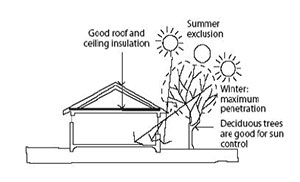
The HIA have produced an easy to read manual as a result of the accreditation offered, and called it ‘HIA GreenSmart Home Owner Manual – Living in your Home with an Environmental Awareness’. There is some great content in the booklet, some of which you would think is just so logical, yet most of us don’t think to apply it – so we have decided to share some of it with you.
This is the first of several articles which we will feature :
Know your Home – Passive Solar Design
Your home has been designed and built with particular features that if understood and operated as intended could help to reduce the need to artificially cool and heat the home in summer and winter, whilst retaining a comfortable home.
To ensure you maximize the passive solar design features included in your home
consider how to :
- Externally shade windows and glazed doors to prevent them from receiving the full exposure of the summer sun
- Purge unwanted hot air from the ceiling space and seek to control the movement of heated air by features such as closing off an internal stairwell or entrance void in two storey homes
- Open doors and windows located in the house to provide cross ventilation for cooling breezes
- Close internal doors and vents to target heating and cooling to areas of the house that are occupied
- Check the seasonal setting of any ceiling fans so that they are operating in winter or summer mode as required
- Where ducted heating is installed after handover consider the placement of the return air grilles. In both single and two storey homes attempt to place these at ground level on the ground floor
- Allow windows to receive winter warmth through removing any temporary shading devicesUse the ventilation systems designed or incorporated into your house to vent steam and hot air in summer
- Draw curtains or blinds to retain heated air in the room in winter and reduce entry of summer sun (dependent on constructions materials and climate)
- Close windows and doors early on hot days to reduce entry of heated air (dependent on construction materials and climate)
- Open up windows and doors (installed with security measures) at night following a hot day to purge heated air
The demand for sustainable homes continues to grow. There’s now a huge focus on healthier building practices, internal fit-outs, resource efficient products and increased efficiency and less waste. To Download the GreenSmart Guidance Book for information on designing and building new homes and renovation projects, CLICK HERE.
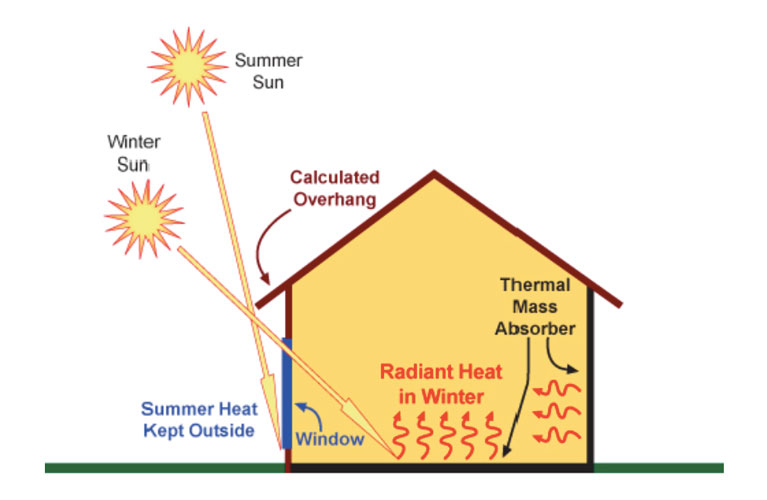
Ipswich Granny Flats only use an architect of some repute for all our Granny Flat Designs. We are proud to say that Russell Wombey is part of our team. Russell was instrumental in the initial ground swell some 40 years ago that started the Passive Solar Movement in Australia. It’s one of our unique points of difference – all our Granny Flat Designs are produced by Russell, site specific for your property – no one else’s.
 NO Donga’s or pre-built Granny Flats craned over your house looking like a transportable house with no wheels :
but quality built, built on site and designed by an architect with passive solar principles in place ! What more could you ask for ?
Cheers, Sun 🙂
For further information, call Sonia 0403 309 136.
Granny Flats for Rent : Investors Most Frequently Asked Questions
Who are Your Most Likely Tenants for Dual Living Properties?
The Downsizers – sick and tired of a big yard to maintain and over paying the mortgage every month. Many people just want a break from the constant commitment of maintenance and mortgages.
The Savers/Newlyweds – young couples, first home buyers, saving for their first home.
The Single Mums – Granny Flats provide security and independence and also usually have a small, easy care garden for the kids.
The Retirees – time to retire and have a place that you can lock up and go travelling for 3 or 6 months and still maintain independence.
What Sort of Rent Return can be Achieved?
Rent is usually the same if not slightly more than a 2 bedroom unit in the area. Most of the appraisals I do for Ipswich and surrounding areas range from $250 – $300 per week, depending on the final product, area and demographic for that particular suburb. An outdoor deck, landscaped garden and car parking facilities all add to the appeal and improve the gross yield.
What is Tenant Demand Like?

Enquiry for Granny Flats for rent is increasing every day. Just this week I had an enquiry from a lady and her son willing to go on the wait list for 3 months to get the right 2 bedroom Granny Flat in the Right Area. The appeal of living independently, paying reasonable rent but also having the basic security of someone close by is appealing – and it’s a growing the trend!
Are there any Extra Costs Associated with these Properties that Tenants need to Factor in?
No. No extra costs associated with renting a Granny Flat. All new Granny Flats have individual electricity, gas and water meters meaning these costs are incurred by the tenant. This is the same as renting a 2 bedroom house or unit with individual meters. Of course there is a bond of 4 weeks rent and 2 weeks rent up front when first moving in, standard procedure in Queensland.
What Sort of Features Appeal Most to Tenants in Ipswich?
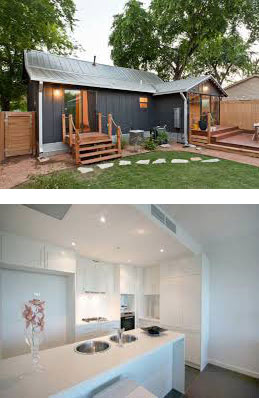
DESIGN – At Ipswich Granny Flats we create modern buildings, all individually designed by an architect with full passive solar orientation, and with visual and acoustic privacy between the two occupants.
LOCATION – Consider access to shopping centres, schools and transport.
FINISHING TOUCHES – adequate soundproofing, quality fittings, ease of access, good-sized bedrooms and bathrooms.
For more information on Granny Flats for Rent
Call Julie Adams on 0411 073 747
Renting out the Granny Flat May Mean Losing Tax Concessions …

Ipswich Granny Flats : We are often asked ‘What happens if we build a Granny Flat in our backyard now, then we go to sell our home at a later date ? What are the tax implications for us?’
I’m not an accountant so I cannot answer the question, all I can do is refer that person to their Accountant or Tax Adviser.
You might find the recent article below provides some useful information …
Dubbo Weekender
15.4.14
Peter Scolari, Scolari Comerford
THE range of “granny flat” scenarios in Australia is quite extraordinary – from the “garden variety” (excuse the pun) to homeowners actually building granny flats in their backyards and leasing them out to people, almost like a business.
While it may not be possible to deal with, or even imagine, all the possible scenarios, this article explains the capital gains tax (CGT) consequences of basic granny flat scenarios. Specifically, it looks at the Government’s tax concession which allows homeowners to sell their home tax-free – this concession is known as the “CGT main residence exemption”.
Basic scenarios
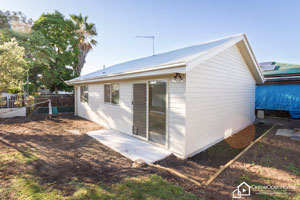
Let’s agree on a basic scenario where a granny flat is built in the backyard or a separate garage is converted into a unit of accommodation for occupation by, for example, your adult children, your elderly parents or your in-laws.
In this situation, assuming no commercial type rent is charged, there will be no loss of the CGT main residence exemption on any subsequent sale of the whole property. Essentially, this is because under tax law the CGT exemption for the disposal of a main residence extends not only to the dwelling, but also to “adjacent land” and structures built on it provided they are “used primarily for private or domestic purposes in association with the dwelling”. This rule would cover the basic scenario described above even if the granny flat occupants were paying outgoings such as electricity, rates and repairs etc.
However, if the granny flat occupants were paying commercial rent, then a partial tax exemption would apply on the basis that the main residence (which includes any adjacent land) was being used for income-producing purposes. That is, there would be a CGT liability for that portion of the property that had been used for renting out the granny flat.

The CGT liability is usually calculated on an area and time basis. If, for example, the income use amounts to only 10 per cent of the area of the property and only occurred for two years until the sale of the property 10 years later, then any assessable capital gain or loss, say $100,000, would be apportioned by reference to this 10 per cent income use for two out of the 10 years – i.e. 1/10th x 2/10ths, being 2/100ths – resulting in an assessable capital gain of $2000 which would be also entitled to the 50 per cent CGT discount as the property had been owned for more than 12 months.
The above calculation is for illustrative purposes only. Real-life will always throw up more complexities. For example, a difficulty not dealt with in the above calculation is that tax law will require you to know the market value of the property at the time the granny flat was first used to produce income.
Even in this case, where commercial rent is charged for occupation of a granny flat, it may be possible to argue, depending on the circumstances, that no partial exemption applies – that is, the full exemption applies. This is because the main residence exemption extends to adjacent land “to the extent that the land was used primarily for private or domestic purposes in association with the dwelling”. In this regard, the phrases “to the extent” and “primarily” may be wide enough to encompass the case where a granny flat is rented at commercial rates for a limited period (at least in relation to the total ownership of the property) – especially if rented to family members. However, it would be prudent to contact us for advice, and possibly obtain a private ruling from the ATO, to verify this view.
Other points to note about these basic scenarios:
In the situation where parent(s) move out of the main residence and let their children or a child and their spouse occupy the main residence as their home, then presumably the CGT main residence exemption will be available on any subsequent sale as it appears that the basic requirements for the exemption will still be met in this situation – provided the parent(s) remain the legal owners of the property. Alternatively, the “absence concession” in the tax law would be available to validly preserve the exemption.
If the land occupied by the separate granny flat is subdivided and sold (e.g. to the occupiers), then no CGT exemption would apply to any capital gain or loss made on the sale.
In the related situation where a room in a dwelling is rented at commercial rates (usually to a non–family member), the situation is clear that a partial exemption for income use will apply.
More unusual scenarios
The range of granny flat scenarios is unlimited due to the variety of family lifestyles and legal uses of land that can occur in this country. This means that there can be as many CGT (and other tax) implications of the arrangements (including land tax) as there are granny flat arrangements.
Take, for example, the not-so-uncommon situation where a couple owns a holiday home on the coast or in the country, and local council laws permit the building of another structure for accommodation on the land (say for a parent-in-law or an adult child working in the region). Assume the couple owns a dwelling elsewhere which qualifies as the main residence for CGT exemption purposes. What would be the CGT and tax implications in this situation?
In this case it would seem that the building of the structure would amount to a capital improvement to the land, the cost of which would be added to the cost base of the land for the calculation of any subsequent CGT liability on the disposal of the land – despite the fact that the structure qualifies as a unit of accommodation which has become the main residence of the occupier. In this case, a key consideration is the fact that the CGT main residence exemption is only available if the occupier has an “ownership interest” in the dwelling, and which is clearly not the case here.
No small matter
In summary, there is a growing phenomenon where people build granny flats in their backyards for the purpose of letting them out on a commercial basis. Clearly, in these cases, the rent would be assessable income, relevant deductions would be available and a partial CGT exemption would apply on any subsequent disposal of the dwelling on the basis of income use. In certain cases, the Commissioner may regard such “enterprises” as a business activity – and require profits and losses to be accounted for on a business basis.
This article has hardly scratched the surface of the granny flat arrangements and the resulting tax implications. The issue of granny flats and CGT is no small matter for a range of reasons, including significant population rises in big cities, increasing immigration levels (and any cultural norms of extended family living), the ageing population, transport issues, rising house prices, and problems with the availability of urban land for development. And don’t forget, of course, the possibility of the revenue available from such scenarios in these budget-strapped days. However, bear in mind that the costs of collecting such revenue may well outweigh any revenue collected.
The above article has been supplied for information purposes only. If you have question in relation to the tax implication of building a granny flat, whether in your own backyard or your investment property – ask the experts!
Talk to your Accountant or Tax Adviser …
Ipswich Investment Property 2014 : Hotspotting, 24 April 2014
Terry Ryder in brief …
Here’s why 2014 is the year of Brisbane and Qld
Why Queensland ?
* Most Australian jobs created in 2013 were created in Qld
* Tourism is in a strong growth phase
* The CSG to LNG industry continues to prosper
* The coal industry is poised for a comeback
Why Brisbane ?
* Brisbane markets are moving strongly into recovery
* Sales volumes have risen markedly in many Brisbane suburbs
* The first signs of a return to price growth are now being seen
Ipswich Granny Flats in brief …
Why Ipswich ?
* The Ipswich market is moving strongly into recovery
* Sales volumes have risen markedly in many Ipswich suburbs
* The first signs of a return to price growth are now being seen – ask any local real estate agent …
* We are the first and only council in Queensland to allow ‘Auxilliary Dwellings’ more commonly known as Granny Flats to be built as investments. Interest and enquiries are growing daily for investors and home owners alike wanting to know how to turn their backyards or investments properties into positive cash flow investment properties.
WANT TO BUY
AN INVESTMENT PROPERTY IN IPSWICH
Call Sonia 0403 309 136
Ipswich City Council is Premier’s Standout Performer
Need another good reason to investment in Ipswich in 2014, read the following article recently published by the Queensland Times (QT, APN Newsdesk).
Premier Campbell Newman has pointed to Ipswich City Council as a standout performer in its determination to get the local economy moving forward and creating jobs through economic development.
Council is Premier’s Standout Performer
QT, Adam Davies
24 March 2014
 WELL DONE: Premier Campbell Newman has lauded the
determination of Ipswich City Council to get on with the job.
Mara Pattison-Sowden
As he marks the second anniversary of his government, Premier Campbell Newman has pointed to Ipswich City Council as a standout performer in its determination to get the local economy moving forward and creating jobs through economic development.
He said the area would continue to become a vitally important region in the bigger south-east Queensland picture over the coming years.
This week it has been two years since the Liberal National Party swept into power and in doing so registered the biggest win in Australian political history.
Mr Newman, talking exclusively to APN Newsdesk, said the government had done everything it said it would do since winning office.
“We have got the economy going, created jobs and also reformed government so it is the best performing State Government,” Mr Newman said.
“Queensland’s economy is now outperforming other states.
“We are the lead economy nationally and all sorts of statistics support that. Queenslanders can be very excited that this will be the engine room of the nation.”
However, Mr Newman said much of the economic growth and development across the region could be put down to the strong and excellent leadership of the Ipswich City Council.
He particularly praised the city’s charismatic Mayor, Paul Pisasale, for being an unwavering champion for the region.
“We think the council in Ipswich is showing the sort of leadership and enthusiasm to take the region forward,” he said.
“As a State Government our philosophy is to create a framework of government and economic development across the state and we expect councils to get on and do their local jobs.
“The Ipswich Council is a standout in trying to get the economy going and creating jobs themselves.
“Paul Pisasale has been a very effective mayor in promoting his community, to get jobs and economic development in his local government area.
“He is one of the standout performers in the economic development space.”
Cr Pisasale said growing jobs and developing the Ipswich economy had been a vital goal for him and the council for years.
“We’ve attracted a lot of industry to Ipswich,” the Mayor said.
“And there’s major announcements to come yet.”
Read the full article here