
Things to Consider Before Leasing your Granny Flat
A great article here, summarising the good and sometimes not-so-good factors to consider before leasing a Granny Flat.
Please note that it actually is possible to lease out and receive an income from your Granny Flat in parts of Queensland – a number of councils do allow it (including Ipswich, Logan, Gold Coast, Moreton Bay…), call us anytime for further information.
The pros and cons of leasing a granny flat in Australia
rent.com.au
May 9, 2019
If you have extra space in your backyard, you may have considered maximising this area by building a granny flat to bring in some extra income. It may be easy to decide you’d like to build one, but it’s important to do your research to do it right.
What exactly are granny flats?
Granny flats are a small unit or apartment that is independent of the main house or has a connecting door from the inside for easy access. They’re generally defined as ‘secondary dwellings,’ which means they’re built on the same lot of land as the main house. They typically have separate entrances, as well as their own bathrooms, kitchens, bedrooms, living spaces and laundry areas.
Who wants to rent one?
These properties used to be used solely for putting up elderly relatives who wanted to be close to family, rather than turning them over to an aged-care facility. But with the return of multi-generational living arrangements and the need to have an extra source of income has made them a necessity for many.
In fact, they’re the perfect solution for students wanting to save money, aging parents needing a little support, tenants wanting to save for a home deposit and even homeowners who want to be able to pay off their mortgages.
What are the pros of investing in a granny flat?
They can be affordable: It’s typically cheaper to buy or build this property type than it is to buy or build a standalone investment property. Long story short, investing in one of these properties could enable you to launch your first investment portfolio without needing to borrow a heap of money.
They can add value: If you erect a legally-compliant property in your backyard, this can work in favour of your property’s total value.
Extra rental income: The amount of extra income is going to depend on the location of your property (as well as how swish your flat is), but this extra building could potentially provide you with a few hundred dollars of extra income each week.
It’s pretty practical: Sure, they’re an investment for your wallet, but they’re good for more than that! Even if you’re between tenants, you’ll be able to provide useful accommodation for friends or relatives who need a place to stay, easing pressure on space inside your house.
What are the cons of investing in one?
You may not love your tenant: If you choose to lease your external property, you will be taking on a tenant who you may or may not love. Don’t forget to do the necessary legwork in advance to make sure you’re renting to a tenant with solid references and no blacklisting history to avoid potentially tense situations.
Potential unforeseen costs: Constructing one of these properties may cost more than you expected. Don’t forget to put aside additional funds to meet any expenses outside of your initial budget.
State and territory legislation: You need to check with your state and territory regulations when it comes to building and leasing. You may find that you cannot rent it out at all, and may only be able to use it for yourself. They may be rented out in NSW, WA, the NT, TAS and ACT, but cannot be offered as rental apartments in QLD, VIC and SA.
Potentially longer vacancy periods: Even though the rent may be lower, you could face a longer-than-average wait while you search for a tenant. Many house hunters won’t choose this option because they’re concerned about the potential for disputes and loss of privacy.
Make sure you do your research
There are always pros and cons to adding a granny flat to your property, so ensure you get plenty of financial and legal advice before you go any further. You should consider the cost of your existing home to decide if it’s worth the money or not, especially if you’re planning on selling soon. With many things to consider, research, planning and asking for good advice before you build is essential to a successful end project.
Think a Granny Flat could be the start to
building your Property Portfolio?
Give us a call, we’ll help you on your way…
Sonia Woolley
0403 309 136
Co-Housing/Group Dwellings – The New Trend for the Future?
A Perth couple have thought outside the square when building a unique eco-friendly subdivision. Similar concepts are readily happening overseas – but how do you think they’ll take off in here in Australia?
Perth’s new way to subdivide: four families, four homes, 40 trees
Emma Young, The Sydney Morning Herald
April 28, 2019
A Perth sustainability expert known for his high-tech low-impact home has upped the ante by revealing plans to subdivide it into four properties while retaining all 40 backyard trees.
Murdoch University lecturer Chris Ferreira says the push towards higher-density urban development in the suburbs lacks inspiring examples, so he’ll use his Hamilton Hill home as a guinea pig.
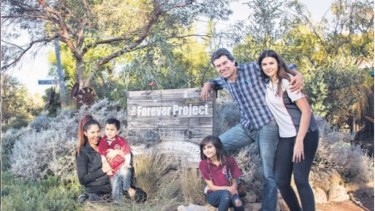
Chris and Astrid, and their children River, Akira and Sarah out the front of the “Hami Hill Sustainable Home”.
He said when he and his wife Astrid first moved into their postwar 1950s cottage it had “all the energy efficiency of a tent,” but after extensive works it has become an example of how people can “live better with less”.
Since 2011 it has been opened to the public once or twice a year and nearly 8500 people have toured it to learn how they can combine eco and health-friendly building materials, slash water and energy consumption and maximise recycling.
“People can kick the tyres and see how to have solar panels, rainwater tanks, greywater systems; how a garden can be the biggest room of your home,” Mr Ferreira said.
Mr Ferreira now wants to challenge commercial and “mum and dad” developers to think outside the concrete box, so at the next home open on May 19 he will walk curious visitors through the details of his new development application.
When the City of Cockburn rezoned the area to R40, he and Astrid saw an opportunity.
“We love where we live and we get heartbroken to see big trees getting cut down for banal infill,” he said.
“Perth is obviously very low density-dominated. Urban sprawl areas such as Gwelup or Success or Butler are generally … classic low density, the quarter-acre big rambling block.
“Perth also does some reasonable high density development – East Perth, for example.
“But medium density is where we do badly. They call it the ‘missing middle’.
“Usually Mum and Dad realise they are sitting on a gold mine and think the only way to realise the value is to plonk an ugly McMansion in what was once the backyard. Everything charcoal grey.
“Or, knock it all down and put in five cheek-by-jowl townhouses.
“We can increase the density of Perth, but in a more intelligent way. We call it inspired infill.”
The plan: four families, four homes, 40 trees
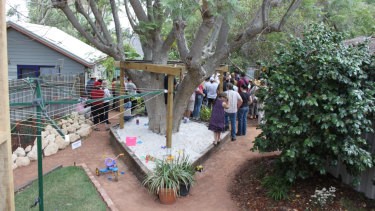
The mighty jacaranda is the centrepiece of the newly created ‘common area’.
The Ferreiras already have a tenanted granny flat on their quarter-acre block, with their tenant sharing their backyard.
They will now build two more apartments.
Mr Ferreria said they had been lucky to work with a “crack team” of a builder-planner and architect who shared the vision and had between them come up with a fantastic design.
The one-bedroom apartments would be one on top of the other, each 60-80 square metres, a standard one-bedroom size.
They would have an energy efficiency rating of 10 (most homes now have a 6-star rating).
They were carefully designed to blend with the garden, main house and granny flat, avoid intrusion on neighbours’ privacy, and to balance private and common space.
The top apartment would have a carefully screened balcony, the lower a private courtyard.
Each faced the massive jacaranda tree that was the “hero of the garden”, complete with tree house, and sandpit in its shade.
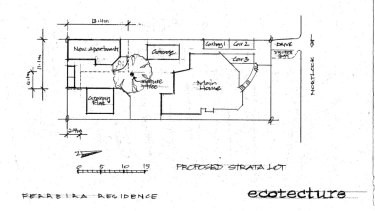
The proposed development.
None of the 40 trees on the block (ranging from 6-70 years old, 5-25 metres tall) will be felled.
All residents will share the wider backyard, its vegetable garden, chook pen, trees and barbecue.
“You can sunbathe nude or whatever you want, in your own private, secluded space but you can go through your door or gate into the shared space when you decide to,” Mr Ferreira said.
“I don’t see it as a compromise – humans need good, meaningful relationships.”
The vision
“I’m feeling very excited about it. It always feels like the next thing we needed to do,” Mr Ferreira said.
“A true community in an urban setting with the density that we need.
“Perth really needs to understand what it means to live in a hot dry environment. Trees and beautiful spaces make us resilient.
“This is not a new concept. In Western Europe you would be used to co-housing or grouped dwellings. It is just unusual in WA.
“The UK now has a Minister for Loneliness. Loneliness is an epidemic. We aren’t designing where people live in order to provide meaningful engagement. That’s what this is.”
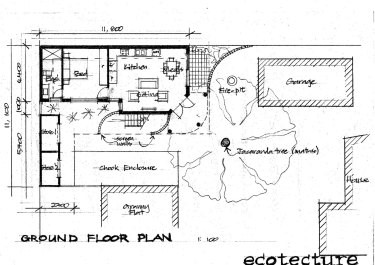
The ground floor plan.
But what about the money… and the council?
The Ferreiras have spent about $5000 upfront on planning and architecture services.
They believe once the apartments go on sale they will be about 5 per cent above normal prices for standard equivalent apartments.
Use of recycled materials where possible will bring the price down.
“If you buy one of those new amorphous townhouses they’ll be so hot in summer and so cold in winter the running costs over three to five years will be much higher,” Mr Ferreira said.
“They are also near Baker Square, an established and functioning community space.”
The Ferreiras have the support of their neighbours on the sides, having carefully designed the apartments to be non-intrusive, and kept them to a double-storey limit.
The City of Cockburn has also been “extraordinarily supportive” and the Ferreiras anticipate development approval within the next few months subject to a few more meetings.
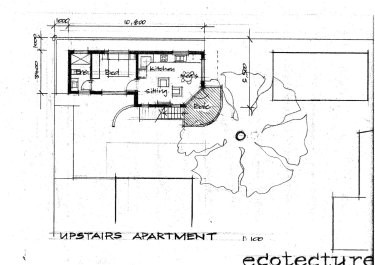
The upstairs apartment.
The City is also supporting follow-on master classes so people can learn to do this themselves.
“The [medium density] design codes for WA are changing at last, so they want this style of development and it will set a precedent,” Mr Ferreria said.
“Cockburn’s planners are passionate about good planning and they haven’t had much power to change the way development is done, so they desperately want examples out there.
“Many councils are very supportive – we are also doing work with Melville, Bayswater, Stirling, Victoria Park, Fremantle and Canning.
“They know the biggest loss [to urban tree canopy] is mum-and-dad developers thinking there is only one way to develop and it’s to chop down everything.
“Big developers, the Coles and Woollies of developers, just build en masse rather than these unique designs and then we all lose out because they look mass-produced.
“But you don’t have to do the traditional development.”
What are your thoughts?
Would you consider converting your property
into something like this?
Sonia Woolley
0403 309 136
Tiny houses now on the Gold Coast – Would You Live Here?
It seems like tiny houses just seem to be getting better and better! There’s so much great planning equating into some stunning designs…would you live here?
Gold Coast’s tiniest houses now complete
Architecture & Design
21 May 2019
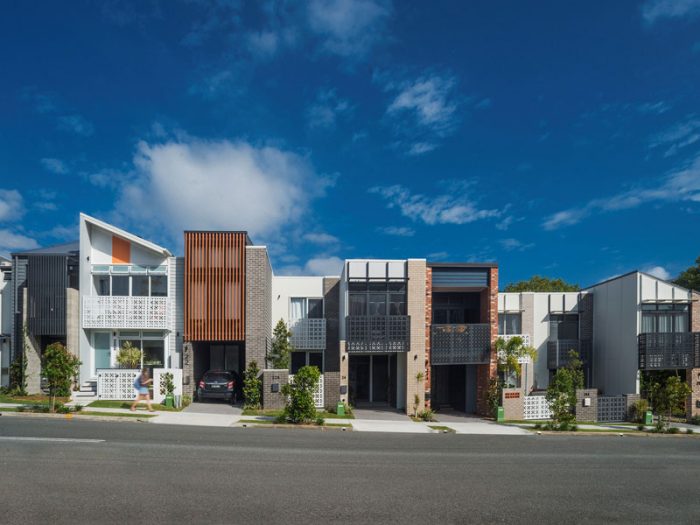
The Gold Coast’s tiniest homes, built on land ranging from 38sqm, have been completed in Southport.
The ENVI Micro Urban Village features nine homes on 10 of the smallest freehold lots in Australia.
The brainchild of architect Amy Degenhart, FRAIA, of degenhart SHEDD, and her original business partner planner Nicole Bennetts, PIA, the homes have been developed on a site totalling 673sqm, on the corner of Meron and Lenneberg streets, which formerly housed a single home.
The most micro home at ENVI, known as the ‘Pico Pod’, measures 61sqm of internal space on a 38sqm lot – about the size of a standard double garage. The home, featuring one bedroom and two bathrooms, sold as a house-and-land package for just over $300,000 to a first home buyer.
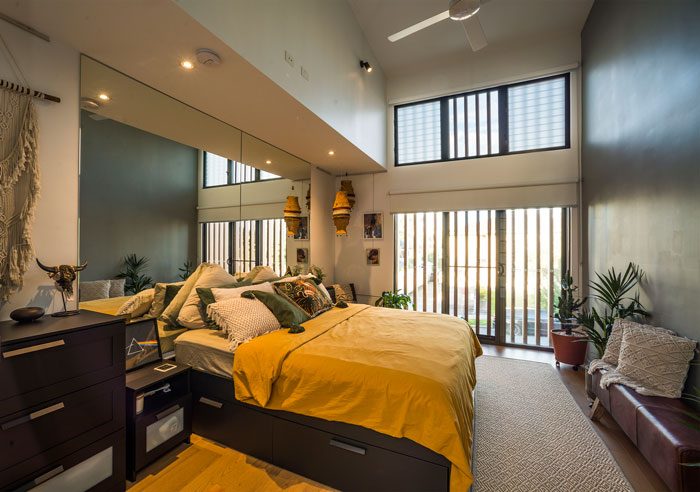
First home buyers accounted for 70 percent of buyers at ENVI Micro Urban Village, all of whom chose Lifestyle Homes Gold Coast for their house build, while the remainder included empty-nesters and a second home buyer. This home ownership pattern is being continued at Garden Terraces, with two more first home owners joining the neighbourhood.
“Savvy micro development is a godsend as house prices continue to rise and inner-city homes become increasingly rare,” says Degenhart.
“This style of project taps into underutilised resources – such as existing streets and pipes – to deliver higher density, affordable living opportunities in highly desirable locations close to infrastructure and lifestyle amenities.
“There is a strong, and growing, appetite for this type of urban living, but there are few projects in Australia that deliver it and it is particularly rare on the Gold Coast. We want to showcase the fact that projects which are architecturally curated can offer more for less – you just need the right vision, community engagement, collaboration, clever design and passion to make it happen.”
According to Degenhart, the ‘Pico Pod’ at ENVI Micro Urban Village was a prime example of taking full advantage of a small lot size.
“The home feels much bigger than it is thanks to generous glazing and high ceilings across the two storeys,” she says.
“At ENVI, we also provided buyers with the choice of opting out of a car space, to further enhance affordability. The ideal location of the project makes this a possibility with public transport, health and recreation amenities, shopping, restaurants, cafes, schools, parklands and employment opportunities all in walking distance of your front door.”
We’d love to speak to you about your property dreams,
no matter how tiny or large they may be…
Sonia Woolley
0403 309 136
Urban Planning Experts increase density to allow for growing population
State governments across the country are looking at ways to cater for our growing population. Townhouses, granny flats, studio apartments and dual-key properties, are among the many housing options gaining popularity in all states. Read here how Perth is dealing with their increasing need for housing.
State government reveals first five sites for Metronet medium-density hubs
Heather McNeill, The Sydney Morning Herald
March 14, 2019
The state government has revealed the first site where a medium-density hub will be developed as part of its Metronet plan to boost housing near train stations.
Situated in Cannington, the site is one of five locations selected by the Department of Communities for between 15 to 40 dwellings to be built.
Other hubs will also be built at sites identified in Claremont, Innaloo, High Wycombe and Highgate.
Architects are being encouraged to consider innovative housing options for the hubs, including townhouses, apartments, ‘Fonzie flats’ (studio apartments above garages), intergenerational homes and dual-key properties.
The five sites will be available for immediate development, pending the establishment of a medium density development panel, which will include a pool of approved builders, designers and architects able to bid on each project.
The 7000 square metre plot of land on Hamilton Street in Cannington, within walking distance to Welshpool and Queens Park train stations, will be the site for hopefuls to pitch their expertise.
Department documents show the proposed land development is within R30 and R60 residential zoning.
The state-issued design brief encourages developers to consider incorporating two or three-storey townhouses combined with apartments.
Dual key properties, which often feature one main entrance to a house with two separate dwellings inside, have been commonplace in countries like Japan and the UK for decades, but are relatively new to Australia.
Further medium-density sites are expected to be developed in the future, with no more than one in every nine dwellings to be considered for public housing.
Housing minister Peter Tinley said the new medium density development panel would help support the delivery of Metronet’s social and affordable housing and jobs package.
“Medium-density developments like the ones that this panel will help facilitate will create diverse opportunities and choice for all parts of the community,” he said.
Metronet aims to accommodate urban infill and better connect Perth through a circular rail network.
In collaboration with that project, the Metrohub plan intends to create “smart and sustainable” density around major public transport links and areas of high social and commercial activity such as hospitals and universities.
Murdoch and Midland have already been touted as future major Metrohub locations.
Urban planning experts generally agree increasing density around major public transport links is the best way to cater for Perth’s growing population.
Committee for Perth chief executive Marion Faulkner welcomed the state government’s medium-density plan, saying Perth had to move away from its tendency to build single-storey homes.
“The thing that we’re the best at, that we’re most prolific at, is single-dwelling housing,” she said.
“We’ve got to find a way forward with all sorts of housing, at all sorts of pricing.
“The (four-bedroom, two-bathroom home) has got a place, but we know increasingly people are going to be living on their own, and so we need to have products for them.”
Increasing density within Perth’s existing suburbs to contain its urban sprawl has been an ambition for the state government for more than 15 years, and statistics show it is heading towards the target of 47 per cent of new homes as infill.
It doesn’t matter where in the country you are, we’d love to share our knowledge with you.
Call us today for a chat about your housing needs!
Sonia Woolley
0403 309 136
Got a $300,000 budget? No problem if you’re looking here!
Feeling disheartened that everything you look at is unaffordable and out of your price range? Take a look at these suburbs, you might just find what you’re searching for!
Affordable havens: The sub $300,000 suburbs on the verge of extinction in Brisbane
Elizabeth Tilley, The Courier Mail
24 March 2019
Suburbs with a median house price of $300,000 or less are on the verge of extinction in Greater Brisbane. So, where can you still buy property for that price in 2019?
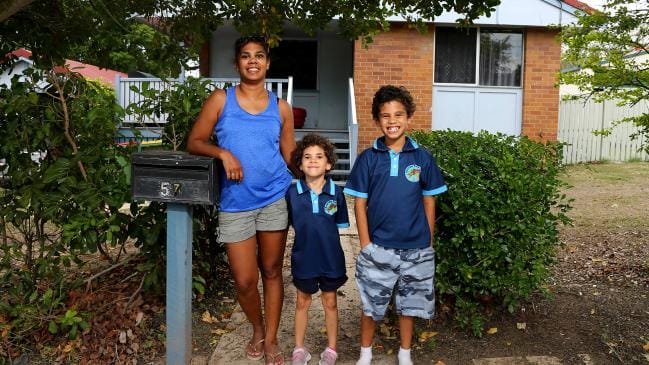
Riverview resident Telita Webb with two of her children, Margaret (5) and MJ (7).
Figures from property researcher CoreLogic show house prices in some of the city’s most affordable postcodes experienced above average growth over the past year, leading to a drop in sales at lower price points.
Only 1.7 per cent of properties in Brisbane changed hands for less than $200,000 in 2018.
In 2019, there are no longer any suburbs in the Brisbane local government area with a median house price of $300,000 or less.
Across Greater Brisbane, there are now only 19 mainland suburbs with a median house price under $300,000, whereas there were double that number a decade ago.
The last affordable havens can be found in the Ipswich suburbs of Riverview, Dinmore and One Mile, in the Logan locations of Kingston, Logan Central and Woodridge and in Caboolture South in Moreton Bay.
The median house price in Greater Brisbane is now $532,000, according to CoreLogic.
More than a third of sales in Brisbane during 2018 were between $400,000 and $600,000, while 7.8 per cent were at $1 million or more.
CoreLogic senior analyst Cameron Kusher said that was a drastic change from the state of affairs over the past couple of decades, with the majority of sales in 1993 and 1998 coming in below $200,000.
“Over time, there has been a steady climb in the share of sales across the more expensive price points,” Mr Kusher said.
“While you’d expect this in the markets that have seen strong value growth such as Sydney, Melbourne and Hobart, we have also seen it across markets where value growth has been much weaker.”
Mr Kusher said that even though he expected slightly more sales to occur at lower price points over the next year, he did not expect any material change in the share of sales under $200,000 — in fact they may reduce even further.
Real Estate Institute of Queensland chief executive Antonia Mercorella said Brisbane still had plenty of affordable suburbs with good quality housing compared to Sydney and Melbourne.
“We have so many affordable options in really high growth suburbs,” Ms Mercorella said.
“They’re not going to run out tomorrow.
“And many are still within a 12km to 15km radius of the city, which is pretty mind-blowing compared with Sydney and Melbourne.”
Ms Mercorella said Brisbane’s affordable havens provided great opportunities for entry level property buyers.
“Many people assume a $300,000 house must be a dump, but that’s just not the case in the southeast corner,” she said.
“Low price does not mean low quality.”
Nick Kruger, principal of Your Haven Realty, said there were still plenty of opportunities for first home buyers to get a foot on the property ladder in Riverview, which has the cheapest median house price in Greater Brisbane.
Mr Kruger said that he had noticed a shift in the buyer profile in the market as a result of the banks cracking down on lending.
“Predominantly, in the past, investors were snapping up these properties for their SMSF because of the good rental returns,” Mr Kruger said.
“Now the banks have cracked down, that’s incentivising a market change.
“It’s better for owner-occupiers now, because they have a chance to get it over investors.
“But in time, obviously these prices will jump so the sooner you can get in, the better.”
He is marketing a three-bedroom house at 57 Price St, Riverview, which is currently leased for $290 a week and is on the market for offers over $245,000.
“That’s a good figure for an investor,” Mr Kruger said.
“At that price point, for a three-bedder on a 600 sqm plus block so close to Redbank Plaza and within 5 minutes walk of sought-after schools, I definitely it’s ideal for first home buyers or young families.”
Single parent Telita Webb has rented the home with three of her children for the past year, but would love to buy the property if she could afford the deposit.
“I love the place; Riverview’s my home,” Ms Webb said.
Chris and Tiffany Campbell live in Bundamba, which is one of greater Brisbane’s last affordable havens — just scraping in with a median house price of $292,752.
The couple are renovating a turn-of-the-century Queenslander, which they recently bought for $315,000.
“Bundamba has a bad wrap; I’m not sure why,” Mrs Campbell said.
“The street we live in is so quiet and full of beautiful, old Queenslanders, and you can see the growth potential.
“I think it is one of those places a lot of people forget about.”
They sold another property last year that they had bought and renovated two years earlier in North Ipswich and made more than $100,000 in profit. “We knew going into it and paying price we did in an up and coming suburb it was going to be a good investment.”
Propertyology managing director Simon Pressley said Ipswich was becoming a popular location for property investors because of its affordability, solid rental yields and good infrastructure.
But Mr Pressley said he was not convinced the region had the ability to create the volume of jobs required to put pressure on the local labour market and drive property prices significantly higher.
“One could do worse than investing in Ipswich, however, my overall rating of the Ipswich property market is a middle-of-the-road performer for the feasible future,” Mr Pressley said.
THE SUB $300,000 SUBURBS ON THE VERGE OF EXTINCTION IN 2019:
Suburb Region Median house Change in median Change in median price Mar 2019 12 mths to Nov 2018 5yrs
- Riverview Ipswich $256,787 -2.3% 13.7%
- Dinmore Ipswich $259,481 9.0% 35.2%
- One Mile Ipswich $260,181 0.0% 15.9%
- Leichhardt Ipswich $264,565 2.1% 22.5%
- Rosewood Ipswich $273,359 6.9% 19.2%
- Logan Central Logan $273,541 -3.4% 26.1%
- Woodridge Logan $274,352 -1.3% 28.1%
- Basin Pocket Ipswich $275,769 -4.6% 25.6%
- Ebbw Vale Ipswich $276,599 -6.1% 20.3%
- Kingston Logan $285,032 -2.4% 24.2%
- Goodna Ipswich $285,329 -4.1% 10.8%
- Tivoli Ipswich $292,168 -2.7% 8.6%
- Bundamba Ipswich $292,752 4% 14.4%
- North Booval Ipswich $293,058 4.6% 17.9%
- Caboolture South Moreton Bay $293,517 0.6% 16.2%
- Gailes Ipswich $293,572 0.7% 11.8%
- Churchill Ipswich $295,020 1.1% 7.2%
- East Ipswich Ipswich $297,405 13% 27.1%
- Wulkaraka Ipswich $299,733 6% 2.6%
(Source: CoreLogic)
Still need help to find the right property for you?
Or are you looking at ways to increase the value of your property?
Give us a call today!
Sonia Woolley
0403 309 136
Entering into a Granny Flat Agreement: Understand all the Elements
With the inquiry into tax treatment of Granny Flat arrangements commencing this year, this is another timely reminder of things to consider out before entering into a Granny Flat Agreement…
Granny flats for aged care caught in Catch 22
Rachel Lane, The Sydney Morning Herald
9 December 2018
Last week the Assistant Treasurer announced an inquiry into the tax treatment of granny flat arrangements will commence in the new year. The review is a result of the 2017 Australian Law Reform Commission’s Report that identified formal and legally enforceable family agreements as a measure in preventing elder abuse. The problem is such agreements can have significant tax consequences.

Ross Higgins a partner at Mills Oakley says: “The problem is revealed in the following simple example: Granny sells her home and pays $400,000 to her son and daughter-in-law for a right to occupy a granny flat they have at the back of their principal residence. The intention is to create legal relations, that is for the rights of the parties to be legally enforceable.
For capital gains tax purposes this is treated as a capital gain of $400,000 less any legal costs of getting an agreement prepared. The capital gain is to the son and his wife. The asset is the right of occupancy created under the agreement and disposed of immediately thereafter. Because the asset is held for less than 12 months the general 50 per cent discount does not apply. The tax liability on $400,000 would be up to $188,000 (that is 47 per cent, being the top marginal rate plus Medicare levy). The tax bill will only be sent after lodgement of the tax return for that year – typically months after the agreement has been signed.”
He says there are other ways to deal with these issues, but many will be caught in this simple scenario with a potentially hefty tax liability.
Tax is certainly one element of these agreements that needs to be considered but other factors such as the impact on pension entitlement, eligibility for rent assistance, cost of a home care package and if needed the future cost of residential aged care also need to be added to the list of considerations, not to mention the effect on estate planning wishes after all these arrangements typically involve the sale or transfer of the family home.
Brian Herd, partner at CRH Law says: “The uncertainty created by the tax implications has long been a deterrence to people entering these arrangements. Ironically this is at the same time when Centrelink is encouraging people to enter into these arrangements with their granny flat exemption rules. People were then exposed to a push/pull syndrome from the government – the ATO warning of the tax consequences and discouraging them and Centrelink encouraging them. Hopefully the ATO and Centrelink will finally align providing a consistent incentive for this wave of family care.”
Removing the tax disincentive for granny flats will encourage families to have a formal agreement, providing certainty for granny and the children. My advice if you are thinking about entering into a granny flat agreement, make sure you understand all of the legal and financial implications, tax is just one element. And be sure to ask the “what if” questions such as “what if the children got divorced?”, “what if the children became sick or passed away?” and “what if I need aged care?”