
A Good Property Manager is Worth Gold – What Your Property Manager Should be Doing for You
There are many horror stories about tenants from hell who wreck properties and cause nothing but headaches for landlords. But it doesn’t have to be like that, and thankfully, in most cases, it’s not! Find yourself a decent Property Manager and relax knowing your investment is in safe hands…
What your property manager should be doing for you
Larissa Ham, Domain
A property manager is responsible for just three major things: finding you a tenant, collecting the cash and carrying out regular inspections. Right?
Wrong, says Emma Gordon, who runs the property management division at Harcourts Victoria. She says property managers – or at least the good ones – now carry out tasks far beyond that.
“The key is a property manager now needs to be a risk manager, to educate the landlord on how to reduce the risk of being a landlord,” says Ms Gordon.
“There are just so many areas now where a property manager has to have knowledge.”
For starters, there’s building insurance to worry about, plus owners corporation rules, smoke alarms, the servicing of gas appliances and window blind and pool fencing legislation.
“A lot of property managers just don’t have any knowledge on, say, if tenants go and put a pop-up pool in the backyard and someone drowns,” she says. “There are just so many areas now where a property manager has to have knowledge.”
The best property managers will also help their client create wealth through property management, says Ms Gordon.
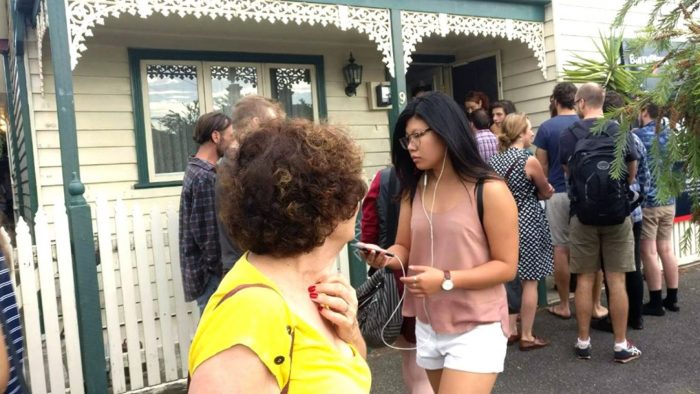
A property manager should also be looking after the tenants, not just the landlord.
That could be done by talking to a landlord about their five or 10-year property plan, by recommending tax depreciation schedules, or putting them in touch with mortgage brokers.
Property managers should also be monitoring the market and suggesting rental increases as often as the market permits, says Ms Gordon. They might also advise on renovations that could help an owner achieve higher rents.
Of course, it goes both ways, and a property manager should also be looking after the tenants, says Ms Gordon. “If you’re not looking after your tenant then in turn you’re not going to look after your property.”

A polite way to tell tenants that their cleaning isn’t up to scratch is to give cleaning tips, one manager says.
Amy Evans, a senior property manager at Release Property Management, says maintenance is another huge area of responsibility for property managers.
“It’s not just reactive – we try to be proactive,” she says.
For instance, if she notices the silicone needs replacing in a shower, Ms Evans will suggest her landlords get it fixed pronto.
“It’s getting that stuff done so you don’t have water damage coming up elsewhere and it causes more inconvenience and massive costs.”
Ms Evans believes it’s also about using experience and knowledge to educate her landlords.
For instance, she is dealing with a case where the landlord, who was planning to sell their property, gave notice to the tenant.
But in the meantime, the landlord’s personal circumstances changed and they decided not to put the place on the market after all.
“If they (the tenant) finds we’re re-letting the property, they could come at the landlord for compensation claims,” she said. “Part of my role as a property manager is to say ‘this is something you need to be conscious of’.”
At the time of writing, Ms Evans had applied to the Victorian Civil and Administrative Tribunal for an exemption to the rules.
Property managers are also usually the ones responsible for having the awkward conversations with tenants – for example, when their cleaning is not up to scratch.
“I always give cleaning tips because that’s the polite way to have a discussion with them about cleaning,” says Ms Evans.
Real Estate Institute of Australia president Malcolm Gunning says a property manager should help take the emotion out of your investment.
A major part of the job is not just collecting the rent, but also acting as a mediator, he says.
Aside from all this, an excellent property manager will regularly give you an idea of what your property’s worth (both in terms of rental income and if you decide to sell), and will know how satisfied your tenant is.
If you can find the perfect property manager, hang on to them tightly.
“A good property manager is like gold,” says Mr Gunning.
Vision Property Group’s Property Management department can provide you with Gold-class service too!
Call Julie Adams 0411 073 747
Investment Advice – The Good, The Bad and The Lessons to be Learned
It can be pretty daunting purchasing an Investment Property, whether it’s your first or your fifth. Everyone has different opinions on what to buy and what not to buy. It’s important to get the RIGHT advice before you sign that contract.
The worst investment advice property experts and investors have ever heard
Christina Zhou, Domain
Buying the worst house on the best street is a classic real estate adage, but it could be among the worst investment advice for those who don’t do their due diligence.
Crumbling houses being marketed as a “renovator’s delight” or a “blank canvas” may appear to be a bargain or an entry in to the area, but it might also require a buyer with deep pockets to do a thorough update.
Wakelin Property Advisory Richard Wakelin said buyers who purchase the worst house on the best street might need to spend a lot of money on rewiring, restumping, re-roofing or re-plumbling. The property might have “hidden costs” and also unfixable issues such as backing onto apartments or light industrial-type property, he said.
Tax depreciation and stamp duty concessions should not be the main considerations for buying an investment.
“It definitely falls into the lure of a renovator’s delight, and most people get badly caught out by what they have to do to get the foundations of the actual building right,” Mr Wakelin said.
Some property advisers point to seemingly attractive tax advantages and stamp duty concessions that come with buying off-the-plan, but buyers who overlook other fundamentals could find themselves stumbling into an investment pit hole.
Investor Neda Tesic, 32, was encourage by her ex-partner and a former financial advisor to buy an off-the-plan two-bedroom apartment in Maidstone, about eight kilometres west of Melbourne’s CBD.

High rental yields could mask the property’s scarcity value.
She sold the property in 2015 for less than what she bought it for in 2008, during which house prices in the suburb took off.
“[They] talked about depreciation and I just took it for what it was, not realising the full story; in terms of how inflated it would be,” said Ms Tesic, who works in sales for an accounting software company. “It was so hard to get tenants in there as well because there were so many other apartments in the area.
“It was a very expensive lesson,” Ms Tesic said, adding that she would now take more time to research and look at comparable sales in the area.

Experts say time in the market is key.
Mr Wakelin said many poorly performing properties were marketed with tax advantages as their main selling point.
Tax attractions such as gearing strategies, depreciation allowances and stamp duty savings might assist the financing of an investment in early years, he added, but they should not be the primary reason to invest, because too often they mask the property’s scarcity value and propensity for capital growth.
While some investors try to time the market, many property experts argue it is better to buy when you can afford it.
“Time in the market” rather than “market timing” was the key, but investors needed to do their research very thoroughly, Mr Wakelin said. “Procrastination is the greatest thief of time.”
An investment offering high rental yields could also raise a red flag.
Allen Wargent Property Buyers principal Pete Wargent said the worst investments over the past decade in Australia had been those where people had focused on the rental yields to the exclusion of almost everything else.
Though mining towns offered rental yields of 15 per cent or more during the mining boom until 2012, it reflected the risk in the asset, he said.
“A lot of people have been badly hurt, particularly since 2012, and I think some of the high-profile locations that have been hit have been small mining towns, but even in some larger areas like Gladstone have had some severe corrections.
“That’s probably been the worst advice in Australia over the last 10 years.”
Sydney buyers’ agent Victor Kumar, director of Right Property Group, said one of his bad investments was a serviced apartment he bought in 2009, with the intention of hosting friends and family and using it as a holiday pad.
Though the gross rent could look really attractive, a lot it goes into the letting fee and running costs, Mr Kumar said, adding that serviced apartments were also very seasonal.
Talk to your local experts before you spend your money – we won’t let you buy a lemon!
Call Sonia on 0403 309 136 – we’re here to help!!
Tiny Homes – They May Be Small but They’re Crammed Full of BIG Ideas!
The world is quickly grasping the tiny home concept and looking at these homes it’s no wonder! They may be small in size but there is just so much to love about these gorgeous designs. What’s your favourite?
The tiny house revolution told in pictures and floorplans
Patrick Wood, ABC News Breakfast
31 October 2017
The micro-home fascination is building in Australia as those driven out of the traditional housing market turn to alternative designs.
Author and researcher Catherine Foster has travelled Australia to document how 21 architects have made functional living spaces in 90 square metres or less.
“We’re not inventing the wheel, we are repurposing the wheel,” she told News Breakfast.
“A few generations ago here in Australia, 90 square metres was a family house.
“It is only in comparatively recent decades that it has crept up and crept up and crept up.”
Ms Foster has now released a book, Small House Living Australia, to showcase her findings and outline the floorplans that work.
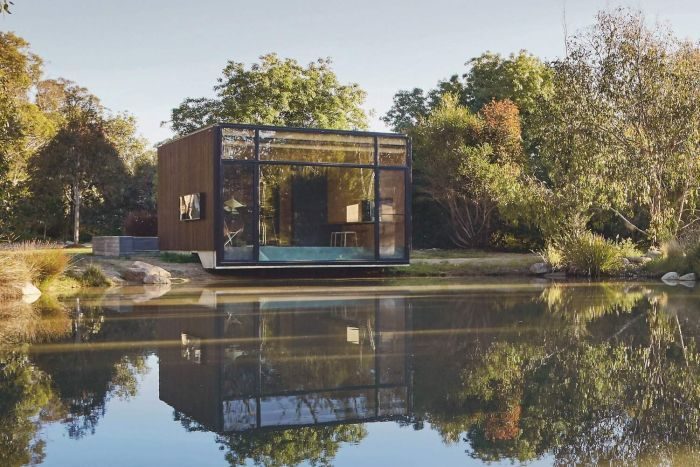
PHOTO: The Balnarring Retreat sits on the water edge in Victoria. (Supplied: Peter Clarke)
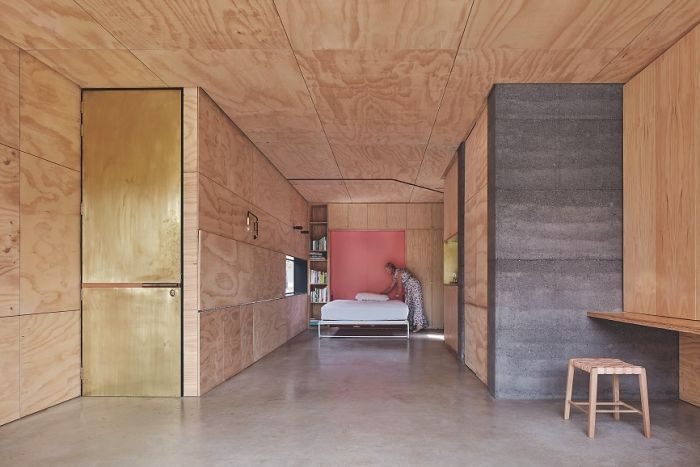
PHOTO: The inside of the retreat shows how simple the designs can be. (Supplied: Peter Clarke)
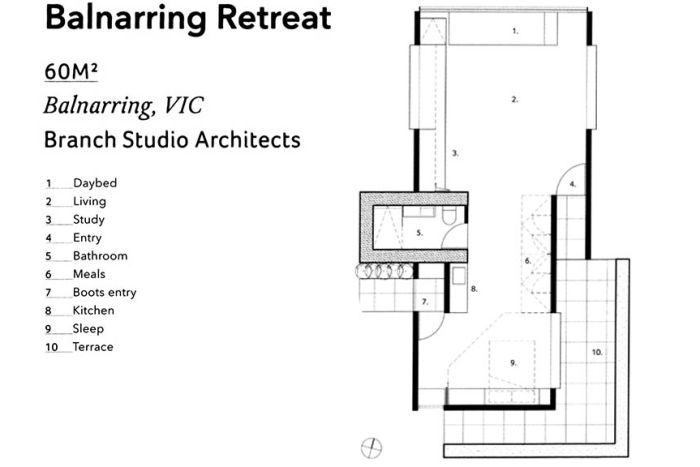
PHOTO: A floorplan of the Balnarring Retreat in Victoria. (Supplied: Branch Studio Architects)
A CommSec study found the average new-home build in Australia in 2015/16 was 231 square metres — just shy of the US average of 249sq/m.
A recent study by Griffith University research fellow Heather Shearer also found a growing interest in small homes in the past two years.
She found people were primarily drawn to the concept for economic reasons, rather than an aesthetic desire.

PHOTO: The Copper House in Sydney takes a tiered approach to space saving. (Supplied: Shantanu Starick)
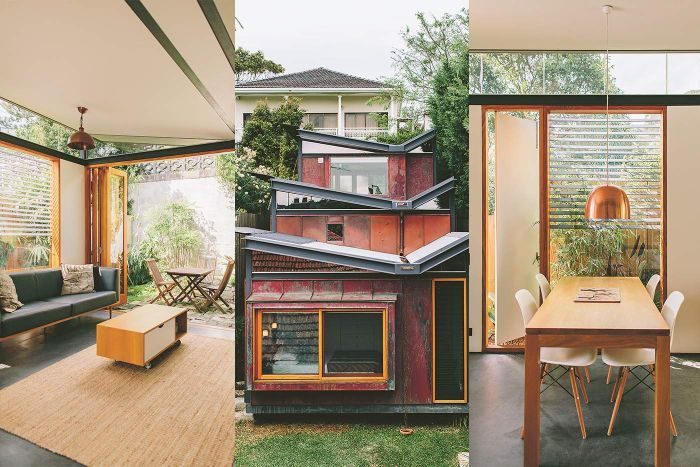
PHOTO: The lounge, outside and dining area show how the Copper House comes together. (Supplied: Shantanu Starick)
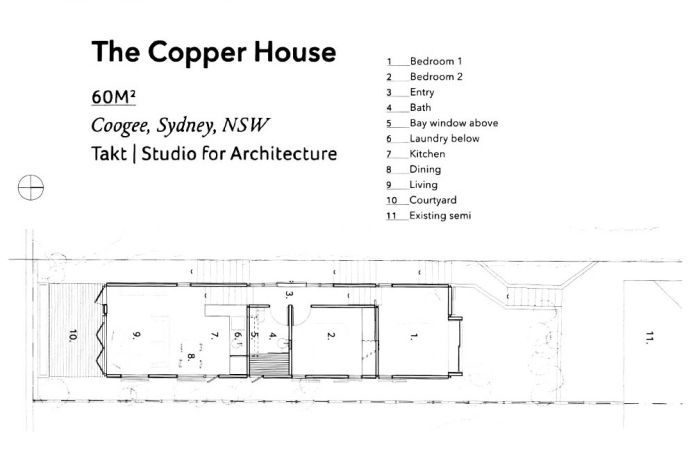
PHOTO: The floorplan for The Copper House in Sydney. (Supplied: Takt Studio for Architecture)
“In a possible reflection of the strong demand for urban living, the most important driver was, ‘Too expensive property in preferred area’,” Ms Shearer wrote.
“Then came: wanting to reduce overall debt, not wanting a mortgage, wishing to downsize, and housing too expensive in general.”
Ms Foster said she found people were seeking flexibility as well as affordability, and that lifestyle was a big factor.
“Young people are [saying] ‘get me a home’ and ‘we would rather it not be out in the suburbs an hour along the motorway, we would rather be close to our community’,” she said.
“Older people, perhaps downsizing and Baby Boomers are going, ‘We want to free up ourselves. We want to go travelling. We want to have a small place where we can go for coffee at the end of the street’.”
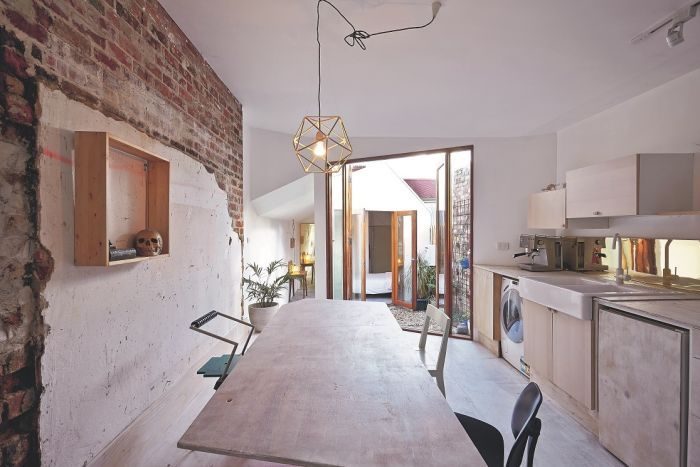
PHOTO: The Doll’s House uses two courtyards in the narrow strip to let in light and offer access outside. (Supplied: Fraser Marsden)
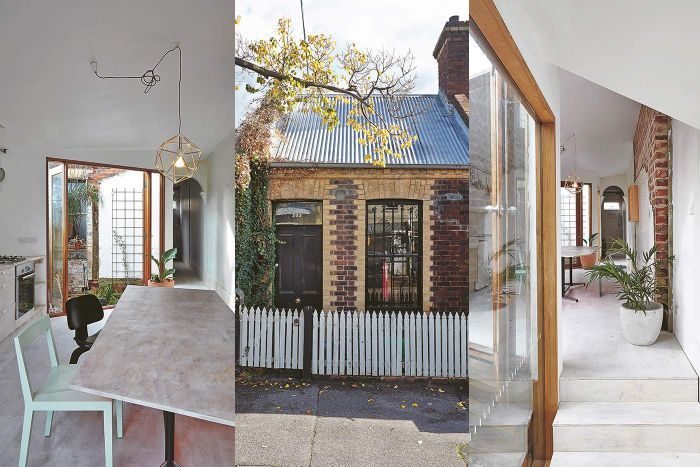
PHOTO: The Doll’s House in Melbourne hides behind a simple facade. (Supplied: Fraser Marsden)
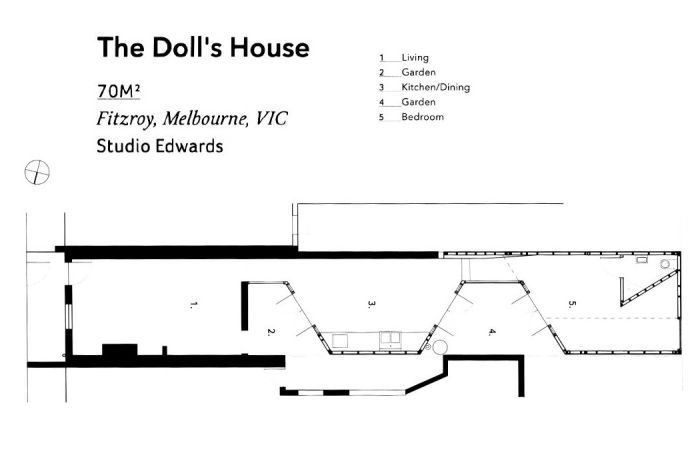
PHOTO: The floorplans for The Doll’s House. (Supplied: Studio Edwards)
When it came to successfully creating a smaller living space, Ms Foster said they key word was “multifunctional”.
“No longer do you have a dedicated room for a laundry or a dedicated room for a TV or whatever. You are going to have those shared,” she said.
“The dining room would be an integrated thing within the living space … they are all there.”
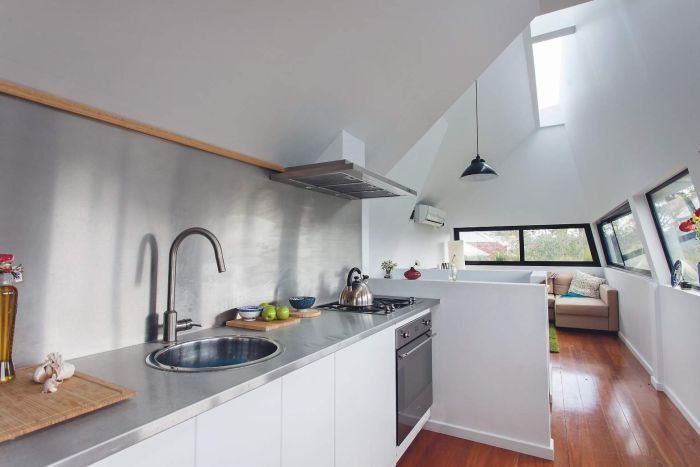
PHOTO: The Grass House has a combined kitchen, dining and living area. (Supplied: Daniel Dixon)
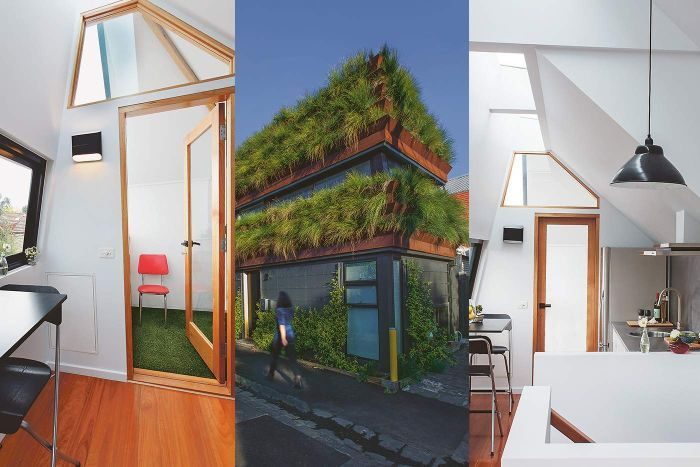
PHOTO: High ceilings create a feeling of space without increasing the floor size. (Supplied: Daniel Dixon)
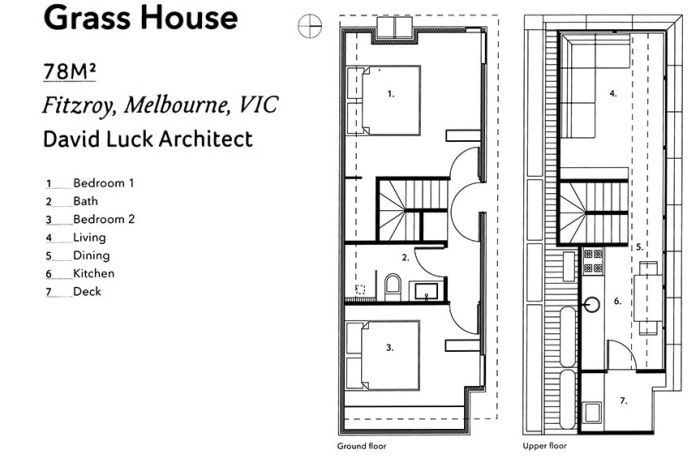
PHOTO: The floorplan for the Grass House. (Supplied: David Luck Architect)
Share your tiny home ideas and desires with us…we might just be able
to help make your wishes come true!
Call Sonia on 0403 309 136
JUST ANNOUNCED – LOGAN CITY COUNCIL’S $23,000 INFRASTRUCTURE CHARGES
Logan City Council has announced this week that as of 1 July 2018, new granny flats and other auxiliary dwellings will be hit with a further $23,000 infrastructure charge… what are your thoughts on this, fair or unfair? And is it really the solution to halting overcrowded developments with inadequate parking and facilities??
Logan to Charge $23k to Build ‘Rentable Granny Flat’
Quest Newspapers
November 3, 2017
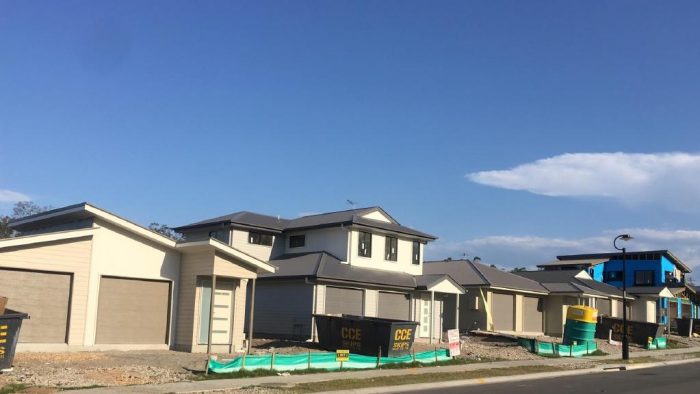
Logan to charge $23K for rentable granny flats otherwise known as auxiliary units.
DEVELOPERS of rentable granny flats in Logan City will be slugged with infrastructure charges of $23,000 as of July 1.
The date was agreed on last week after some developers complained an abrupt change in the rules would unfairly leave property investors out of pocket.
Complaints were mainly from those who had bought blocks of land but were yet to get council approval to build two rentable units.
The council decided last month to crack down on the practice, known as auxiliary units, after residents’ complaints about the lack of parking and pressure on sewers and local parks.
The average infrastructure charge for an auxiliary unit, or rentable granny flat, in Logan will be $23,000 and will be levied at the plumbing and drainage approval stage.
Division 5 councillor Jon Raven said the charges were critical to discourage entire streets of dual occupancies being built.
“But we also need a reasonable time frame. March would be my first preference, but aligning payments with the financial year makes sense and gives investors time to plan for the changes,” he said.
An officer told last week’s City Growth committee a minimum lot size of 700sq m and a minimum 18m frontage would slow the practice.
Watch out Boys, Women are Stepping Up in Property Investment!
It’s been a long time coming, but now the proof is out there… women are just as good (and often better!) at making smart decisions when it comes to property investment!
It’s great to see that women are successfully taking control of their future!
Women’s property investments outperform men’s
Aidan Devine, The Daily Telegraph
October 13, 2017 11:00pm
Women are putting a new twist on the outdated and somewhat offensive suggestion their place is in the home — by making more profit from home ownership than men.
Analysis of Australian Taxation Office (ATO) figures has revealed women are proving more adept at investing in real estate over the long term, buying properties with better returns and long-term growth.
The proportion of women who own an investment property has also risen at a faster rate than men in recent years, despite women earning less than blokes on average.
Calla Property’s Susan Farquhar, who mentors men and women on getting into the market, said Aussie women were better investors because they took a keener interest in property and were more comfortable committing to a mortgage at a younger age.
They were also better at saving for a deposit, more inclined to seek advice and less prone to risky investments, she said.
“Women tend to start when they’re below 35, often when they’re still single,” Ms Farquhar said. “Much fewer men will invest when they’re single and they tend to wait till they’re older and in a secure relationship.”
Women’s keener focus may help explain changes in the gender balance of property ownership.
Roughly 13 per cent of women taxpayers owned an investment property in 2010 but in five years the figure rose to 15.2 per cent, according to ATO data.
In the same period, the proportion of men with an investment property was fairly consistent, going from just under 15 per cent to 15.7 per cent.
Men were also more likely to rely on negative gearing benefits, claiming an average $9904 per property in the 2014/15 financial year compared with $7253 for women.
About 47 per cent of all investment properties are now owned by women.
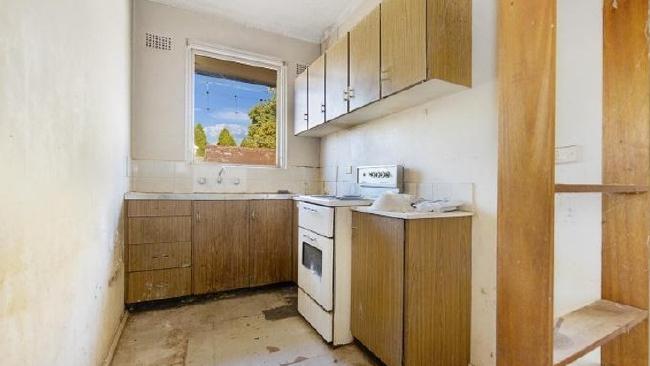
BEFORE: Investor Carla Barton’s property in Dulwich Hill purchased for $505,000 and later sold for $640,000.
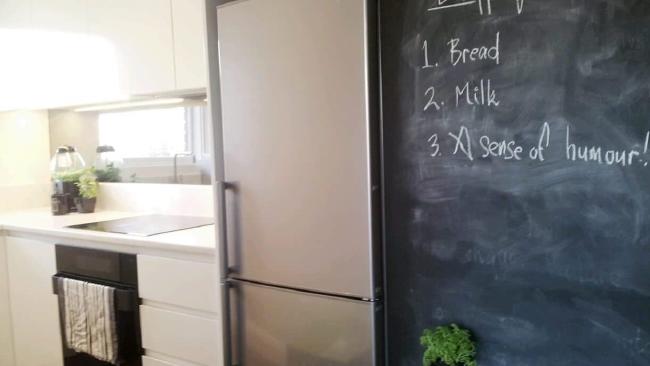
AFTER: The Dulwich Hill home after a $40,000 renovation.
This success in the property market mirrored results in other asset classes, such as shares. A US study of 8 million investors in 2016 by investment firm Fidelity revealed women outperformed males by 0.4 per cent over the year.
Investment tracking app Openfolio revealed a similar trend after evaluating 60,000 American investors, showing women’s returns performed better in the past three years.
Property Women mentoring group director Jo Vadillo said women often lacked confidence, which tended to be an advantage.
“They know they need to do research,” Ms Vadillo said.
“They are not easily impressed with glossy sales speak or agents’ sharp suits and cars.
They look at the house and the numbers, assess who the tenants will be and take the time to conduct due diligence.”
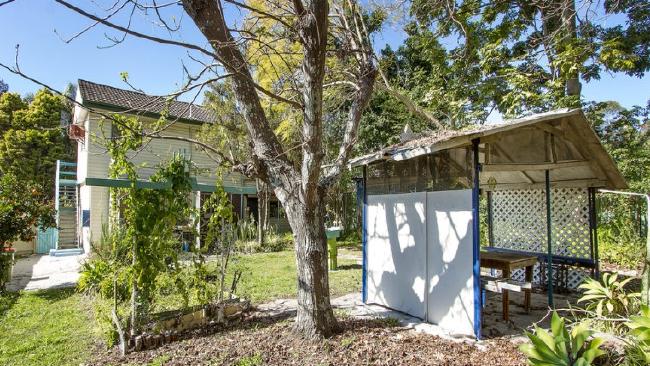
Investor Diana Lovasi bought this home in the Central Coast and added a granny flat.
A lower appetite for risk was another key advantage for women, Ms Farquhar said.
“Men are more likely to gamble and take risks, so more will buy in ‘hot spots’ or mining towns,” she said. “Women take a longer-term focus and want to minimise their risk. That’s vital for being successful … because it’s a long-term thing.”
Investor Carla Barton, 31, has made hundreds of thousands of dollars from flipping houses in her spare time and said she attributed her success to a cautious approach.
“I’ll only buy homes 15km from the Sydney CBD because I know it’s very difficult to lose money there,” Ms Barton said.
She recently bought a unit in Dulwich Hill for $505,000, renovated it for $40,000, and sold for $640,000. She’s now renovating a Leichhardt house for $1.2 million in a joint venture.
Investor Diana Lovasi, 34, is onto her third property deal, despite only starting investing just four years ago on a $55,000 a year income.
“I feel like women have to start earlier,” Ms Lovasi said. “If you want to have children and take time off work to care for them you have to sort out your finances when you’re younger.”
Are you ready to take control of YOUR future?
Let us help you find security and build wealth!
Call Sonia on 0403 309 136
Pools, granny flats, views and sheds – What is it that will attract tenants or buyers to your property??
A great article here showing what tenants and buyers are putting at the top of their wish lists! Pools and granny flats can add so much appeal to your property, creating both lifestyle and financial attractions. Even something as simple as adding a shed might just make your property stand out above the one down the road. The article may be written about WA properties but our experience tells us that it’s just the same here in QLD! Have a think about what you can do to your property to make it more in demand…
Why pools rule the real estate hunt
Josh Zimmerman, PerthNow
October 8, 2017 2:00am
PROPERTY hunters scouring the internet have pools and granny flats at the top of their wish list, while Mandurah is the most popular suburb for real estate clicks.
Mandurah has powered to the top of realestate.com.au search ranks thanks to retirees looking to cash in on their ageing Perth homes and escape the hustle and bustle of city life, according to property experts.
The coastal community topped WA search rankings for the past two years and is on track to defend its crown again in 2017, with more than 172,000 searches up to last month.
Swimming pools are by far the most sought-after feature, racking up more than 101,220 searches this year, with hard-to-shift adult children and the revenue on offer through short-stay accommodation leading granny flats (23,600) into second.
REA Group chief economist Nerida Conisbee said Mandurah’s popularity reflected a growing trend across Australia.
“The kind of lifestyle on offer is becoming more and more important for people buying a house but they also don’t want to pay too much for the privilege of being near amenities or the beach,” she said.
With a median house price of $290,000, Mandurah remains significantly cheaper than the Perth average of around $500,000.
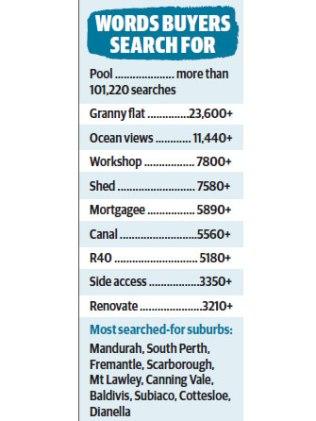
Ms Conisbee said swimming pools consistently topped search rankings nationwide and granny flats were becoming more sought after as children waited longer to leave the nest and, since the advent of websites such as Airbnb, were also viewed as lucrative money-spinners in the right location.
“If you’re in Scarborough or Mandurah or a nice beachy area, having a granny flat for short-term accommodation definitely offers a financial return,” Ms Conisbee said.
Raine and Horne real estate sales consultant Randolph Watson said he was enjoying the busiest period of his six-year career with over-50s flocking to join Mandurah’s laid-back coastal community.
“Mandurah has always been known as a holiday destination and has that holiday feel year round,” Mr Watson said. “We’ve got the most extensive canal system in the whole of WA and a water lifestyle that no other region can offer.”
Mr Watson said Mandurah also boasted world-class health facilities, extensive shopping and easy access to Perth by rail.
He said many Mandurah buyers were motivated by the value on offer, especially retirees looking to unlock equity in family homes closer to Perth.
“Often the homes they are living in are getting old and dated,” he said. “They can come to the Mandurah or Peel region and find the lifestyle they want, buy a home that is much more modern and also bank some cash.”
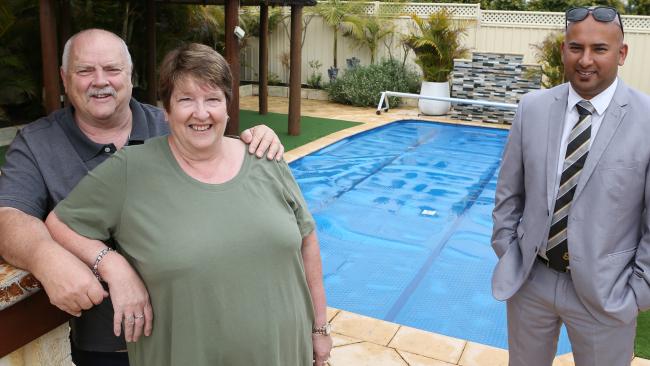
After years living in Canning Vale, David and Lesley Wakefield recently bought a four-bedroom, two-bathroom home with a swimming pool on a 750sqm block in Pinjarra, just outside Mandurah.
“We don’t want to be living on top of anybody else,” Mrs Wakefield said. “Pinjarra is even slower-paced than Mandurah which is a big attraction for us. We’ve got no need for shopping and big crowds.”
Our experience tells us that tenants and buyers and looking for the same things here in South East Queensland! Talk to us about ways to enhance your property to ensure you are getting top returns when it comes time to rent or sell.