
Blog
Family flat (Granny flat) posted on the 20th July 2015
Ipswich Granny Flats, your local Granny Flat Experts, bring to you another interesting snippet :
Christchurch City Council
6 May 2015
The requirements for a family flat on a property.
Under the Christchurch City Plan
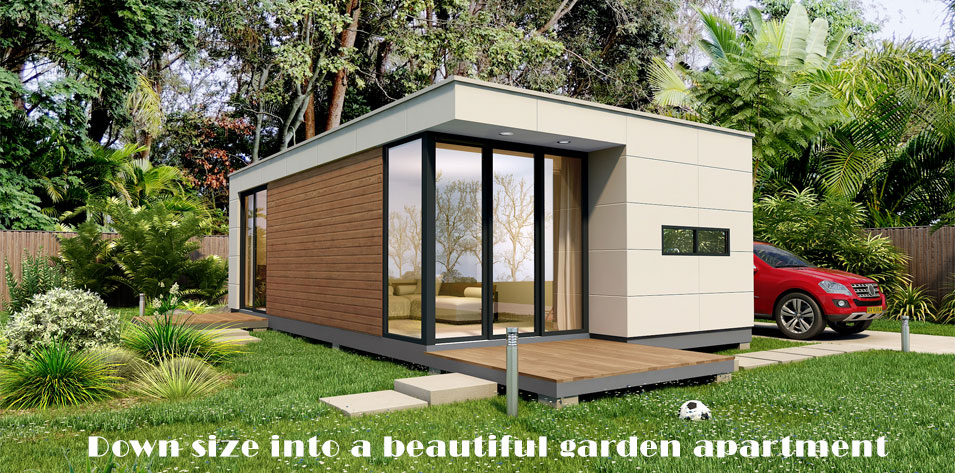
A family flat or ‘granny flat’ means self-contained living accommodation which is occupied by a family member who is dependent in some way on the household living in the residence. The flat can be either contained within a residential unit, or located in another building separate to the main residential unit on the site.
To ensure that the use of the family flat is limited to dependent family members of the household living in the residential unit, the City Plan requires that a legal encumbrance be placed on the certificate of title.
Under the City Plan the maximum gross floor area permitted for a family flat is 65m2 excluding terraces, garages, sundecks and verandas. When the building is no longer needed as a family flat, if it does not comply with all the rules for a residential unit the building is required to be relocated from the site, or the kitchen removed so that the building is no longer self-contained.
When a family flat is no longer needed and the necessary work has been carried out the owner can request the removal (discharge) of the encumbrance from the certificate of title using this form: Request for Discharge of Encumbrance: Family Flat Conversion (Form P-014b) [PDF 241KB or Doc 278KB]
Please note: a sleepout that is not self-contained (i.e. no kitchen) is not defined as a family flat and is covered by different rules.
Under the Banks Peninsula District Plan
The Banks Peninsula District Plan provides for a family flat as an accessory building. It is recommended that you speak to the Duty Planner on 941 8999 to find out the rules for your particular property if you are thinking of constructing a family flat in the Banks Peninsula area.
Family flat encumbrance
A family flat encumbrance is essentially a promise to remove the flat or its kitchen if the flat is no longer required for a dependent relative.
The Council arranges for preparation and registration of the encumbrance on the certificate of title for the property, together with your own solicitor. To request an encumbrance for a family flat, please fill out the application form: Request for encumbrance (Form P-010) [Doc 217KB or PDF 33KB]
Building work is unable to commence until the encumbrance is registered on the title, so to avoid delays, it is recommended that you submit the request for encumbrance form and the fee either before or when you submit any application for building consent.
Encumbrance fees
Refer to the Resource Management schedule of fees for registration and discharge of encumbrances. Please note that these fees do not include your own solicitor’s fees. The preparation of the encumbrance or discharge document is done in consultation with your solicitor, as it is a legal document.
Conversion of family flats for general occupation
A family flat that was existing on 6 December 2013 can be converted into a residential unit that can be occupied by anyone, if certain requirements are met. This is one of the housing intensification measures introduced by the Land Use Recovery Plan (LURP), which was approved by the Minister for Canterbury Earthquake Recovery in December 2013.
The requirements for converting a family flat are outlined in this information sheet: LURP Housing Intensification Provisions: Converting a Family Flat into a residential unit in the Living 1, 2 and H zones [PDF 64KB]
After a family flat has been converted, the owner can request the removal (discharge) of the encumbrance from the Certificate of Title using: Request for Discharge of Encumbrance: Family Flat Conversion (Form P-014b) [PDF 241KB or Doc 278KB]
Removal of a family flat when it is no longer needed
If a family flat (or its kitchen) has been removed because it is no longer required for a dependent family member, or if the flat becomes a permitted activity under the City Plan rules, you can request the removal (discharge) of the encumbrance from the Certificate of Title using: Request for Discharge of Encumbrance forms P-014b [Doc 278KB] and P-014c [Doc 242KB]
A Council Officer may inspect your property to be satisfied that it is appropriate for the encumbrance to be released. In addition, a building consent will be required to remove the flat or services, i.e. kitchen and plumbing.
Written by Sonia Woolley